Games · Review
Issue 01 · September 2026
Games · shoot 'em up · arcade · Windows, macOS, Linux / SteamOS +2
HELIOBANEA Ship Built to Kill the Sun
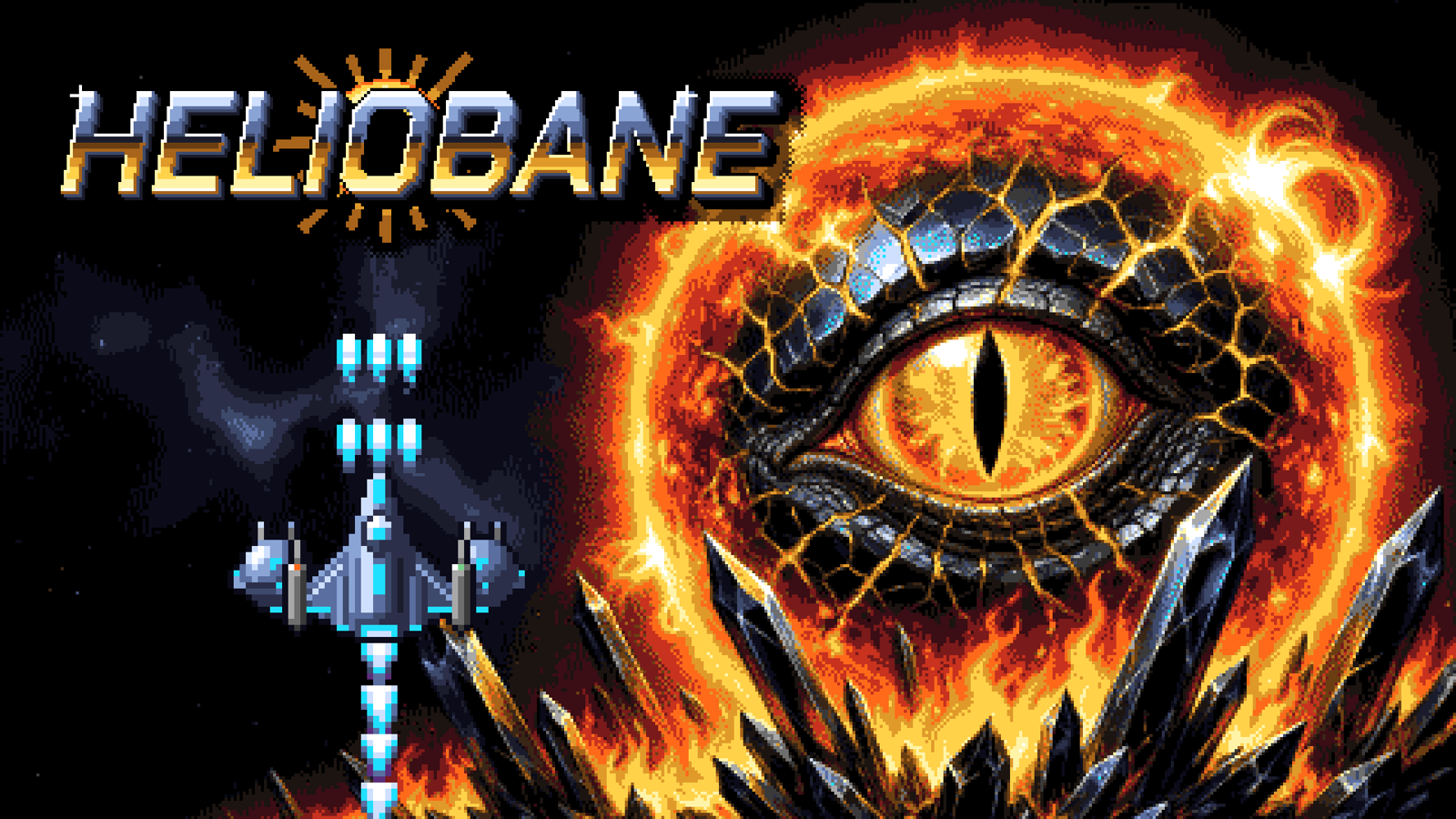
HELIOBANE doesn't hide where it comes from. Its design document lists its ancestors one by one, then adds APIDYA and BATTLE SQUADRON for good measure.
Fact sheet
- Platform
- PC, Android, Amiga (AGA)Windows, macOS, Linux, Steam Deck
- Developer
- Gand
- Publisher
- Gand
- Genre
- shoot 'em up, retro
- Price
- $9.99 unconfirmedAndroid $4.99 unlock, Amiga free
- Release
- 30 October 2026 unconfirmedAmiga 2.0.0: 20 October 2026
- Turkish
- interface, full voice-over, subtitles
Spoiler warning: the game's ending is told under its own subheading. Friends who don't want the surprise spoiled can skip that section.
TYRIAN 2000, XENON 2 MEGABLAST, PROJECT-X. If you've ever flown a ship up a scrolling screen on the AMIGA, you know these names. HELIOBANE doesn't hide where it comes from. Its design document lists its ancestors one by one, then adds APIDYA and BATTLE SQUADRON for good measure. It was made by GAND, a small independent studio in Tokyo, which is also publishing it. It was made in a quick fashion. The PC version is on Steam and Epic, and by the time you read this it will be out.
This piece isn't based on the game itself. It's based on the developer's documents: the design document, the world lore and the development notes. Nobody played the game for this issue. When these lines were written the PC version wasn't out yet, so there were no Steam user reviews to read either. Here are the prices and platforms:
-
PC (Steam and Epic): $9.99. Steam has a 20 per cent discount during the launch window.
-
Steam demo: Free. It has the first three stages of World 1 and was in Steam Next Fest until 26 October.
-
Android (Google Play): Listed on the site as "out". The first three stages are free, and the rest unlock with a single $4.99 in-app purchase.
-
iOS: Not released yet.
-
AMIGA: This is the real news. A separate version for AGA machines is free on itch.io (you can donate if you like). Since version 2.0.0 on 20 October, all 15 stages and the ending are in this version too.
Now let's move on to the ship.
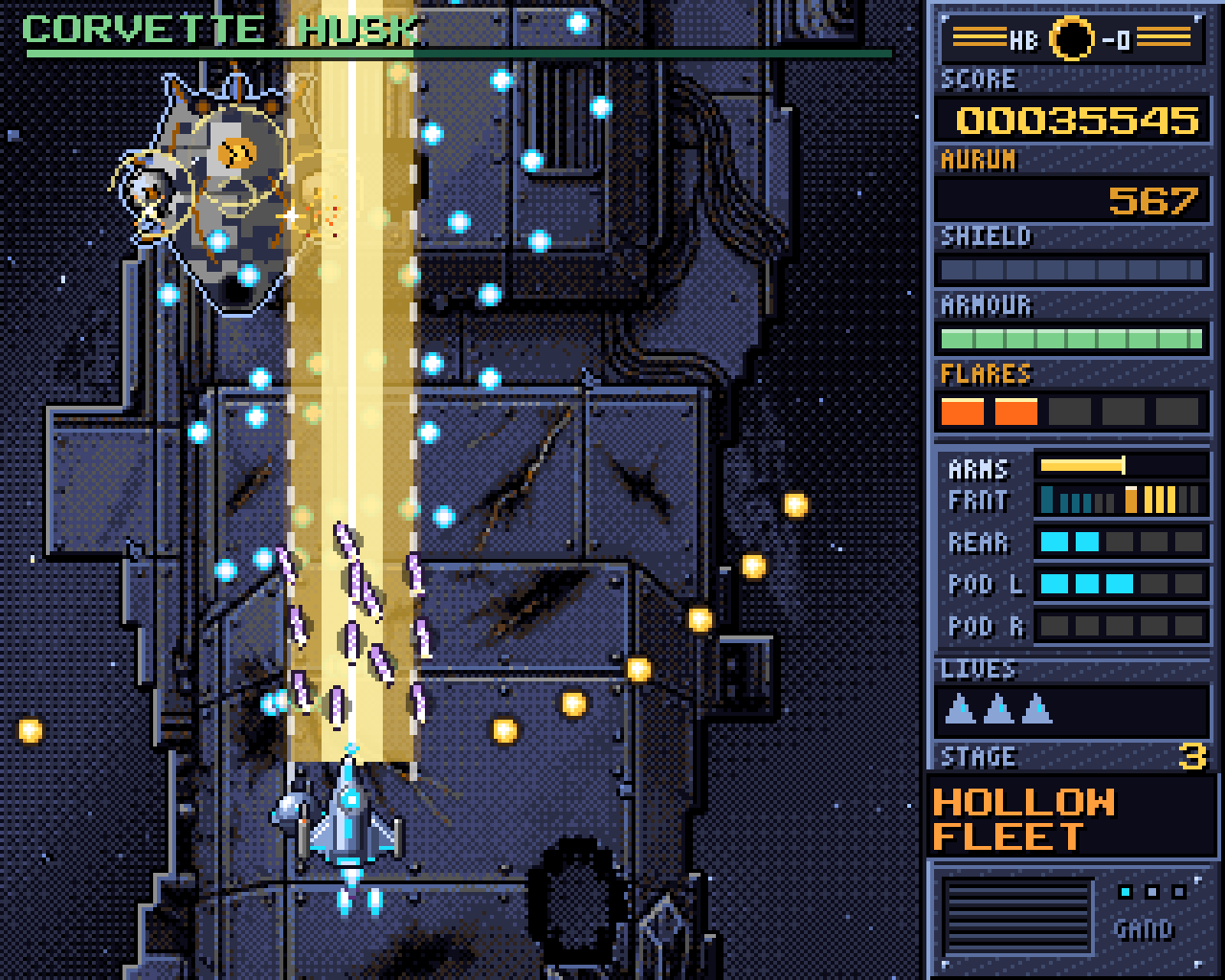
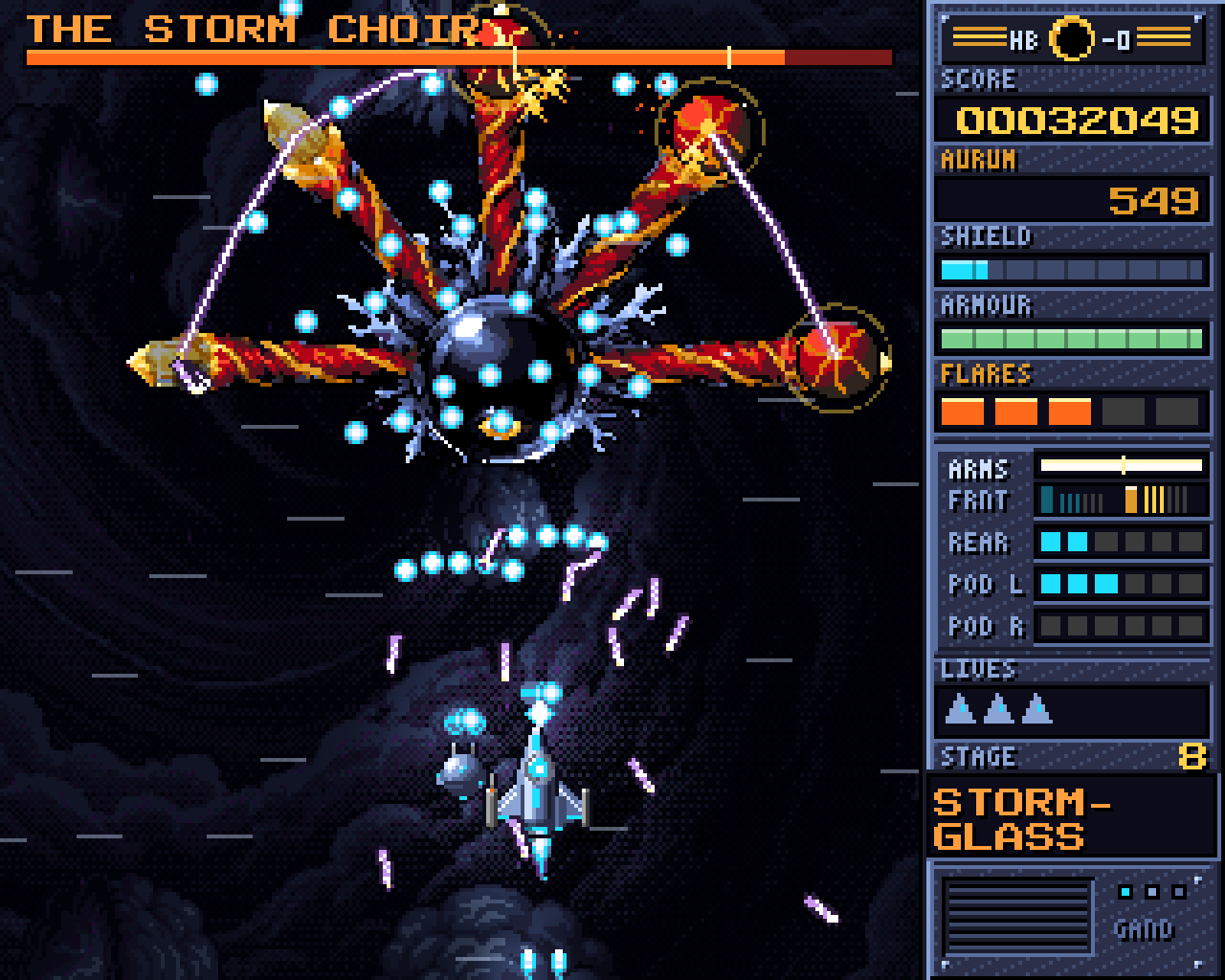
One ship, five slots, two barrels
The name HB-0 "Heliobane" means "sun killer". You kit the ship out the Tyrian way. There are five slots: two on the front weapon rack, one for the rear weapon, and two in the left and right side pods. The front weapons will look pretty familiar:
- The PULSE CANNON, which fires straight
- The SCATTER VULCAN, which fans out
- The LANCE LASER, which pierces
- The HUNTER SWARM, which homes in
- The HELIX WAVE, which weaves as it travels
The second slot on the rack opens before stage 2. You can switch between weapons instantly, with a 6-tick gap between shots. That's there for a reason, because the game's whole design sits on top of that switch.
Every weapon deals one of three damage types: kinetic, beam or explosive. And every enemy is made of one of four materials. Flesh enemies take normal damage from everything. Glass ones cut bullets down to a quarter but take 1.5 times damage from beams. Sun-fed enemies are weak to kinetic. Beams, though, they swallow: they start to glow and fire up to twice as fast. Concord armour doesn't care about almost anything except explosives. The rule is written like this: "It can be resistant, but never immune." The hit sparks tell you how you did. Hit a weak point and you get a cream-coloured spark. If there's resistance, a grey spark comes with a "tink". When a beam gets swallowed, you see a golden glow and hear a sizzle.
Why does this system exist? The documents say so plainly. The verdict on the first build was short: you hold down fire and dodge bullets, and that's it. Every decision was made in the shop, every enemy took damage from every weapon, and dodging earned you nothing. For the fix they borrowed from classics like IKARUGA, RADIANT SILVERGUN, PSYVARIAR and CRIMZON CLOVER. If you ask me, this is the game's strongest side. The Tyrian formula left all the strategy to the shop between stages. HELIOBANE pulls part of that decision into the middle of the wave.
Then there's the heat gauge. If an enemy bullet passes within 10 pixels of your ship, you get +1 heat. A kill on a weak point gives +3 heat. When heat reaches 50, the BREAKER fires: a white-gold column, one second long, from the ship's nose to the top of the screen. But listen: the BREAKER does almost no damage. Everything it touches is left "pierced" for 6 seconds. A pierced enemy counts as flesh, loses its armour, and its sealed cores crack open. Defence is FLARE's job: it wipes every bullet off the screen, does 60 damage to everything and gives you 1.5 seconds of invulnerability. Splitting attack and defence across two separate buttons like this is smart. Kills closer than 40 pixels to the ship also drop double gold, so the brave get paid.
The Magpie and the price of dying
Between stages you drop in on the Magpie, Old Mott's patched-up tug. Mott sells weapons he "definitely didn't steal from the Concord armoury" and calls you "kid". In the shop you buy and upgrade weapons. Sell a weapon and you get half its price back (the XENON 2 rule). Armour is repaired at 2 Aurum a point, and flares cost 150 each. Once per visit you can also buy an extra life for 1,500 Aurum.
The death rule was changed during development, and if you ask me, they changed it the right way. Levels you bought in the shop aren't lost when you die. A death takes away one power level you picked up during the stage, from a random slot, and makes you drop the salvaged weapon you're holding. The document puts the rule like this: a single death must never start a downward spiral. In old-school shoot'em ups, losing all your gear to one death and switching off right there was an everyday thing. This rule goes straight at that problem.
Three worlds, fifteen stages
The game has 3 worlds with 5 stages each. Every stage has a mid-boss and a screen-filling, phase-changing HERALD. On paper the variety is pretty wide.
World 1 (AUREL): Teaches you the materials. At the end, in the middle of a black-glass cathedral, the INSATIABLE HEART waits with an eye that blazes like the sun.
World 2 (WAKE): Built on glass enemies and darkness. You pick out the enemies by their white edges and their eyes. Here FLARE doubles as a lantern. Every stage has its own idea:
- In Ashfall Drift the screen scrolls the other way, and in its last phase the SHROUD drops in behind your ship, where the BREAKER can't reach.
- In Halvard's Rings the ring ice is breakable terrain that cracks in chains.
- In The Stormglass, wind belts push both the ship and the bullets. The sun-fed kites here punish the "beam everything" habit the previous stage taught you.
- The Heliopause is a speed stage in the THUNDER FORCE IV style. The screen speeds up to three times, and it's pitch black everywhere.
World 3 (UMBRA): Built on mixed-material formations and R-TYPE-style corridors. Here you have to switch weapons right in the middle of the wave. In The Vein the vessel walls open and close to the beat of the music. In Ossuary of Stars the path splits in two like in DARIUS, and with an idea taken from BORDER DOWN, if you die on the hard path before a certain point, you drop down to the easy one. The CHOIRMASTER freezes every bullet on screen for 40 ticks with one long note and serves up a grazing feast. The FIRST MOUTH covers the whole playfield, and its armour turns into every material in turn.
On top of all that, each world has a secret side lane. Inside there's a special weapon and a half-boss that escapes after 120 seconds. In every run the waves are reshuffled from a seed. Numbers swing ±20%, and now and then red-ringed "veteran" units turn up. On paper every stage has an idea of its own. How those ideas feel on the screen, though, only players will be able to tell us.
Dressed as an AMIGA, with today's comforts
The picture is real PAL low-res: 320×256 resolution, a single 32-colour master palette, integer scaling only. The playfield is 240 pixels wide, with an 80-pixel side panel on the right, Tyrian style. The music is tracker modules, around 160 to 180 BPM per stage. The shop plays a swinging 120 BPM blues (a pretty fitting choice for shop music). The speech has been crushed down to 8 bits and about 11 kHz to imitate the AMIGA's Paula sound chip. Underneath, today's expectations are covered: a locked 60 fps, a 4×4-pixel hitbox, keys you can remap separately for keyboard and gamepad, Steam Deck support. There's full voice acting and subtitles in eight languages, Turkish among them. There are 50 achievements on Steam.
For a retro magazine, though, the juiciest part is the AMIGA version. It was written from scratch in C and 68k assembly. It reads the PC game's data and plays back the same input to check that the simulation comes out the same as on PC. There are two builds: one for a 68030 and up with fast RAM, the other for a stock A1200 (68EC020, 2 MB chip RAM). Both need Kickstart 3.0 or higher. According to the documents, on a stock machine some of World 3's late HERALD fights slow down, arcade style. The 68030 build runs close to a full 50 fps. The secret lanes are only in the fast RAM version, because they didn't fit in the stock machine's memory. I liked that the documents admit this detail honestly.
Spoiler: The ending
This section tells you how the game ends.
The game's first line belongs to Chief Engineer Oda Venn, who built the ship: "We built it to kill a star. We never thought we'd have to." Oda secretly designed the reactor so that when it's overloaded, the ship itself becomes a second Sun Lance, and wrote this down in a log note only the pilot could find. The ending is built on that. At the FIRST MOUTH, the pilot Wren overloads the reactor and flies the ship inside. The mouth closes and the ship doesn't come back. The last transmission is Wren's voice laughing at one of Mott's jokes. On a flawless run finished without a single continue, one more final scene is added: the tug picks up a faint signal again. Paying off in the ending what the first line set up is solid storytelling. And a last scene saved for the flawless run is a good reward in this kind of game.
Doubts
The praise has to stop here, because the documents themselves record some serious doubts. Balance testing wasn't done with people but with bots that play on their own. The developer writes in their own notes that this is a weak yardstick. And a design review done during development found quite a list:
- Every bot run on Easy ended at about 2 million points, while the Normal runs stayed between 0.23 and 1 million. In other words, on the leaderboard Easy beats Normal.
- Hard mode only takes 0.6 of the difficulty that ramps up as the stages go on. That's why the review says Hard is only really hard in World 1.
- World 2 gets easier towards the end.
- The PLANET CLOCK fight takes about 60 seconds with a Lance and Hunter loadout. With Pulse and Vulcan it takes 143 to 262 seconds, and the game gives you no hint at all that you should bring an explosive weapon.
- The damage readout in the shop doesn't account for piercing. So Lance and Helix look like downgrades.
None of these suggestions made it into rc9's data. The economy also goes loose after World 1. By stage 15 the Aurum you've piled up reaches 11,500 on Normal and 31,600 on Easy. Weapon levels 6 and 7 only plug part of that hole.
Length is another question. According to an estimate taken from the stage timelines (not measured on people), a clean run is 70 to 85 minutes of flying. There's no arcade mode, no medals and no online leaderboard, just a local top 10. What brings you back will be the difficulty levels, the secret lanes and the waves that change every time.
World 2's darkness is a risk too. Keeping the enemies readable took an outline pass and a colour pass, and a darkness limit was added to the settings. How that feels in play isn't documented.
Then there's the matter of AI. The developer says openly on the store page that some of the visuals, voice-overs, sound effects, in-game text and translations were generated with AI. They also say the music was made in a custom tracker that works with AI. According to the music documents, the tracks were first checked by measurement, with nobody listening. World 1's audio was approved by ear later. For some readers this may change the verdict. Weigh it up for yourselves.
What are players saying?
Nothing yet for the PC version: no Steam reviews, no critics' pieces, no Next Fest numbers on record. The AMIGA side is livelier. According to the developer's log, players have sent long gameplay videos filmed on real hardware, plus bug reports. Some of them finished the World 1 demo twice in the first week on a machine with an 060 card. The complaints that came in were fixed: washed-out colours, side pods not being drawn, Kickstart 3.0 support, Esc to get back to Workbench. The pass made after the colour complaint was carried over to the PC game as well. If you ask me, players on real machines changing the game with their feedback is the most reassuring part of this whole story.
Verdict
On paper, HELIOBANE adds a real layer of decisions to the TYRIAN formula. The material system, the two-weapon rack and the BREAKER were designed together as the cure for a game that's nothing but holding fire and dodging. The game's open risks are written right there in the documents: balance was measured with bots, the difficulty levels are muddled, and the economy goes slack after World 1. For anyone who wants XENON 2's shop and RADIANT SILVERGUN's weapon choice in one game, it's an interesting piece of work on paper. Friends with an A1200, though, don't wait: install the free AMIGA version and see it on your own machine. The PC version costs $9.99; before you buy it, I'd suggest a look at the first player reviews. Only those reviews will show whether it keeps the promises it makes on paper. Those of you who play it on a real AMIGA, send us your notes. I'm waiting for your letters. Good luck...
Disclosure: Heliobane, Gand Games and Farstrand are this magazine's editor's own projects.
Sources
- Primary source heliobane.gand.games
- Press kit heliobane.gand.games
RETRO page · A Ship Built to Kill the SunIssue 01 · September 2026