Hardware · handheld · emulation · Linux handheld
Anbernic RG DS Plus: Two Screens, One Hinge, One Gigabyte
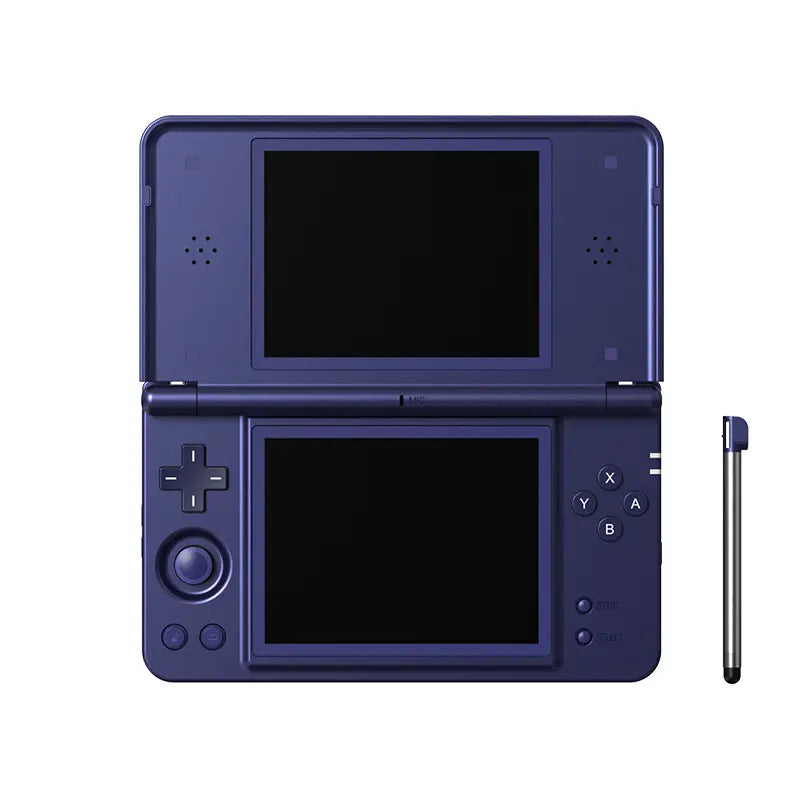
What's the smartest way to fit a games machine in your pocket? Shrink the screen? Slim down the body? Neither, if you ask me. The best solution is to split the thing down the middle and put a hinge in between. Close the lid and the screens protect each other; open it and there are two screens facing you at once. It goes in a pocket, it doesn't get scratched in a bag, and when you're done it goes up on the shelf like a notebook. And nothing suits a job like that better than a little gadget that opens and closes like a book. This month's feature is exactly that kind of gadget: Anbernic's new dual-screen handheld, the RG DS Plus.
First we'll look at the price and what comes in the box, then the screens and the processor, and last of all the places where owners have been grumbling. Let's say it up front: we don't have a unit yet. This piece is based on Anbernic's technical data and on what buyers and the first reviewers have reported.
Price and box
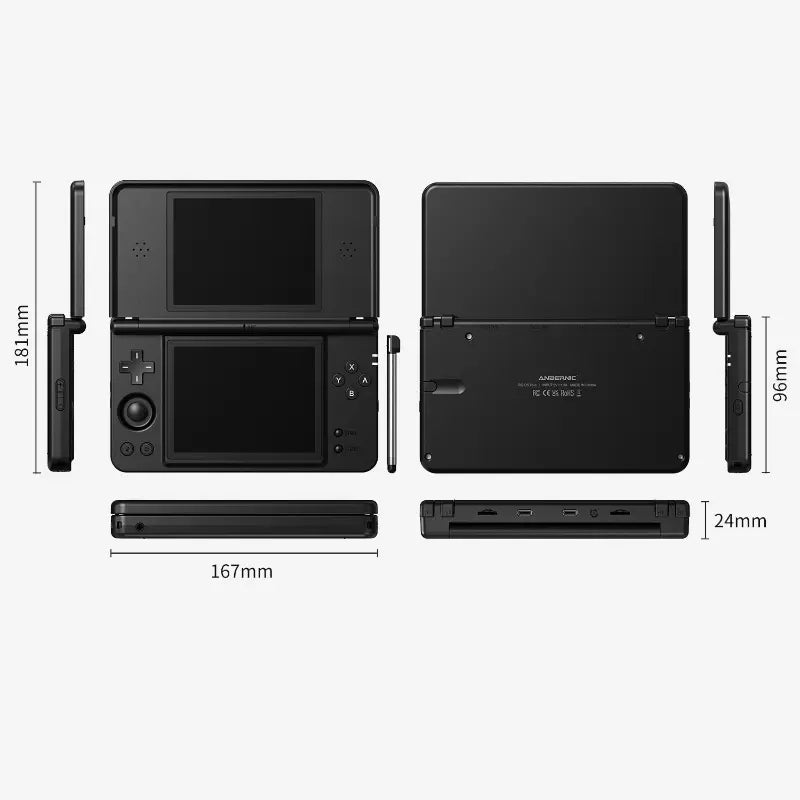
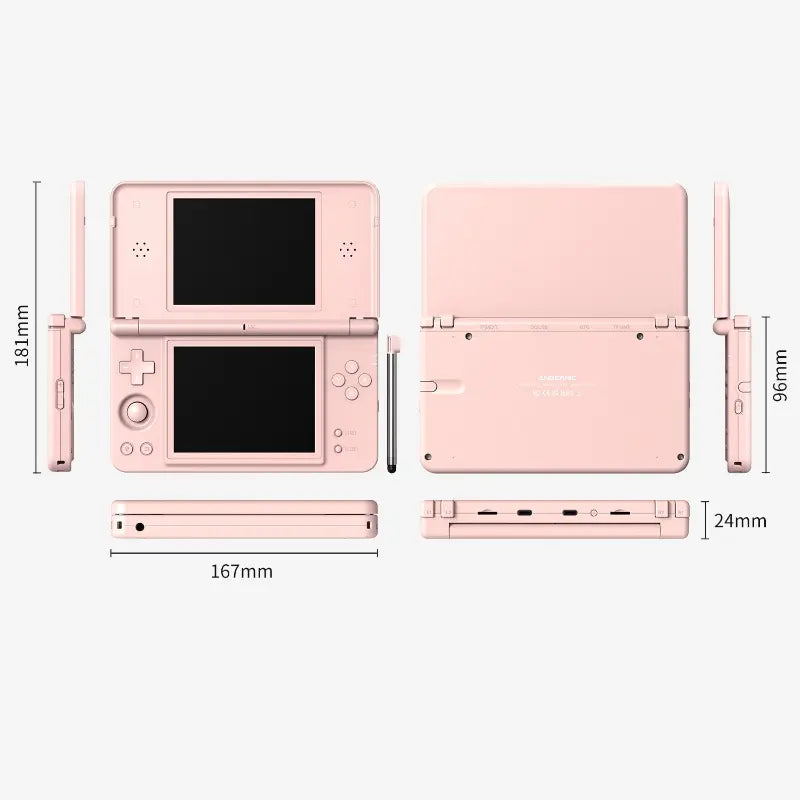
Anbernic first showed the device in a blog post dated 9 September 2026, but that post gave neither a price nor a date. According to Notebookcheck's report, sales opened on 15 September. According to the same report, there was a $10 launch discount until 3 a.m. on 18 September (US Pacific time). With that discount the 16GB base bundle dropped to $84.99. The 64GB bundle sold for $99.99 instead of $109.99, and the 128GB bundle for $114.99 instead of $124.99. These dates and figures don't appear on Anbernic's own page right now, so Notebookcheck is the only thing they stand on. The store page today has a single option: $94.99 with a 16GB TF card. The bundles with bigger cards are gone from the list. The colours are metallic blue, matte black and coral pink. If you like, you can add a protective case for $9.99.
In the box you get a cable, a stylus (touch pen), two screen protectors, a user manual and a wrist strap. The device measures 16.7 × 9.6 × 2.4 cm and weighs 344 grams. In other words, it fits in a pocket, but the pocket will sag for it.
Screens: exactly four times
The device's real claim to fame is its screens. There are two 4.3-inch IPS panels, one on top and one below, and both run at 1024×768. Don't think that number was picked at random. The Nintendo DS screen is 256×192 pixels, and 1024×768 is exactly four times that. So every DS pixel maps to a 4×4 square on the new screen, that is, 16 pixels (this is called integer scaling, meaning whole-number scaling). No shifting, no blur, and none of that business where some pixels look fatter than the others.
So couldn't the previous model do this? It couldn't. The RG DS that came out in 2025 had 4.0-inch screens at 640×480. That meant blowing the DS image up by 2.5 times. With a fractional scale, either you soften the picture or the pixels come out unequal in size. Looks like somewhere in the past year Anbernic finally got its calculator out.
The panels are fully laminated with OCA (a bonding that leaves no air gap between the glass and the panel). The bottom screen supports multi-touch and works with the stylus; the top screen has no touch. The stylus hides inside the body and, according to owners, isn't sold separately. DON'T LOSE THE STYLUS. You are now personally responsible for a part that can't be replaced.
Processor and memory: the diagnosis is in
Inside sits a Rockchip RK3568: four Cortex-A55 cores running up to 2.0GHz and a Mali G52 2EE graphics unit. A perfectly adequate chip for DS emulation. But there's a problem in the memory department. The RG DS had 3GB of RAM; on the Plus that has shrunk to 1GB. Let's make the diagnosis: chronic memory insufficiency, congenital condition. There's no cure either, because the RAM is soldered on and can't be upgraded later.
This cut comes at a price. The previous model ran Android as well. The Plus runs only Linux. The thing owners complain about most is exactly this drop in RAM. There are also reports of uneven performance in PSP games. Now let's ask ourselves: is it fair to expect perfection on PSP from a machine built for DS emulation? It isn't. But if there's anyone out there looking at the price tag and thinking "eh, that'll probably run too", consider yourselves warned.
NNDDSS: the emulator in the box
Anbernic ships the device with its own in-house DS emulator, NNDDSS. Its features are as follows:
- Screen swap: Used to swap the top and bottom screens.
- Bottom-screen touch: Maps the DS touch screen to the real touch screen.
- Shader: Lets you choose among 76 different filters to apply to the image.
- Save state: Stores the game's current state, independently of the game's own save system.
- Real-time clock: Makes games that run by the clock and calendar work correctly.
- Microphone: Uses the device's microphone for the blowing and voice sections of games.
- Cheat support: Lets you enter cheat codes.
After sales opened, the emulator got two updates, v1.0.1 and v1.0.2. But what changed in them isn't explained anywhere. An update without a changelog is like a letter with nothing written in it. You open it, you read it, and you still learn nothing. On documentation, it's fair to say Anbernic gets an F.
For those who find the stock software a bit too plain, there's another road. According to owners, the device runs GammaOS Nano, a third-party firmware. This system pulls game covers from the internet (box-art scraping) and supports RetroAchievements (an achievement system bolted onto old games after the fact) in softcore mode. That is exactly the benefit of the device having an open Linux system. Other people can roll up their sleeves too.
Storage: your card, your system
There's no internal storage. The operating system boots from the 16GB TF card that comes in the box, and there's a second slot for games (up to 2TB). Most reviewers count this as a flaw. I think it's worth looking at from the other side too. The whole system lives on a removable card. That means you can copy it, rewrite it if it goes bad, and if you want to try another system, put the old one away in a drawer. In an age of account-bound, locked-down machines, that's a rare kind of freedom.
But TF cards aren't immortal. So here's my advice: BEFORE YOU SWITCH THE DEVICE ON FOR THE FIRST TIME, MAKE AN EXACT COPY OF THE OPERATING SYSTEM CARD. If the card becomes unreadable one day, you don't want to be left holding a $94.99 hinge and nothing else.
Hinge, body and buttons
The hinge is stepless and dual-alloy. It holds at any angle you like between 15° and 180°. A Hall sensor inside (a circuit that detects a magnet's magnetic field) puts the device to sleep when the lid closes and wakes it when it opens. The old DS's best-loved habit has been kept intact. Owners' comments on the body are positive too. The matte surface doesn't hold fingerprints, the rounded edges don't tire the hand in long sessions, and the hinge stays firm at whatever angle you give it. Mind you, the device is very new, and nobody knows yet how this hinge will be doing a year from now.
On to the buttons. According to owners, the shoulder buttons click loudly. If you don't want to wake the person next to you while playing in bed at night, keep that in mind. There's a single analogue stick, and it sits on the left below the D-pad. Some reviewers didn't like this stick, and the complete absence of a right stick is also on the complaint list. The stylus tip is found to be hard, and there's said to be a slight lag in touch. Reviewers agree that it doesn't reach the precision of a real DS. There are also reports of input lag and emulation oddities in some games.
Let's run through the rest quickly. The device has Wi-Fi 5 (2.4 and 5GHz) and Bluetooth 4.2. The speakers face upward and are stereo. Add to that a 3.5mm headphone jack, a microphone, a rumble motor and a USB-C port. On the software side, online multiplayer via Netplay and game streaming from a PC are also supported.
Battery: the numbers don't agree
The battery is 4000mAh. Anbernic claims six hours. The numbers from owners and reviewers, however, don't line up. Gardiner Bryant reported between 3.5 and 4.5 hours in DS games, Geeky Gadgets about 4 hours, and Time Extension about 6 hours. What creates the gap is most likely screen brightness and the kind of game being played. But for a realistic expectation it's safer to take the middle figure. Charging is at 5V/1.5A and there's no fast charging. A full charge takes 2.5 to 3 hours. In sleep mode the battery drops about 4% overnight, so closing the lid and leaving it till morning is no problem. As for heat, none of the reviews mention it at all.
Verdict
The first reviews are positive. Time Extension gave the device 8 out of 10. Gardiner Bryant and Geeky Gadgets didn't give a score, but both are positive. What the praise has in common: the screens scaled by four, the stylus tucked into the body, and the hinge that holds whatever angle you want. What the complaints have in common: 1GB of RAM, no internal storage, and a single analogue stick.
To my mind the situation is clear. The RG DS Plus is a DS machine and should be judged as a DS machine. For that job, for about $95, it gives you two integer-scaled screens, a body that closes like a book, and a system that sits on a card you can copy. On that count, it's the tidiest option in its class that I can recommend. Every rose has its thorns: the clicky shoulder buttons and the hard stylus tip are among them. But if your aim is to play PSP and beyond on the same device, the 1GB of RAM and the single stick are telling you "no" from the start. In that case you'll need to look at another machine.
Yes, that's it for the RG DS Plus feature. If you decide to buy one, copy the system card first, and don't forget to put the stylus back in its place. The rest is up to your game library and your autumn evenings. That's all for now; hoping to see you next month.
Sources
- Primary source anbernic.com