Games · Review
Issue 02 · October 2026
Games · metroidvania · platformer · Windows, macOS, Linux +1
FARSTRAND
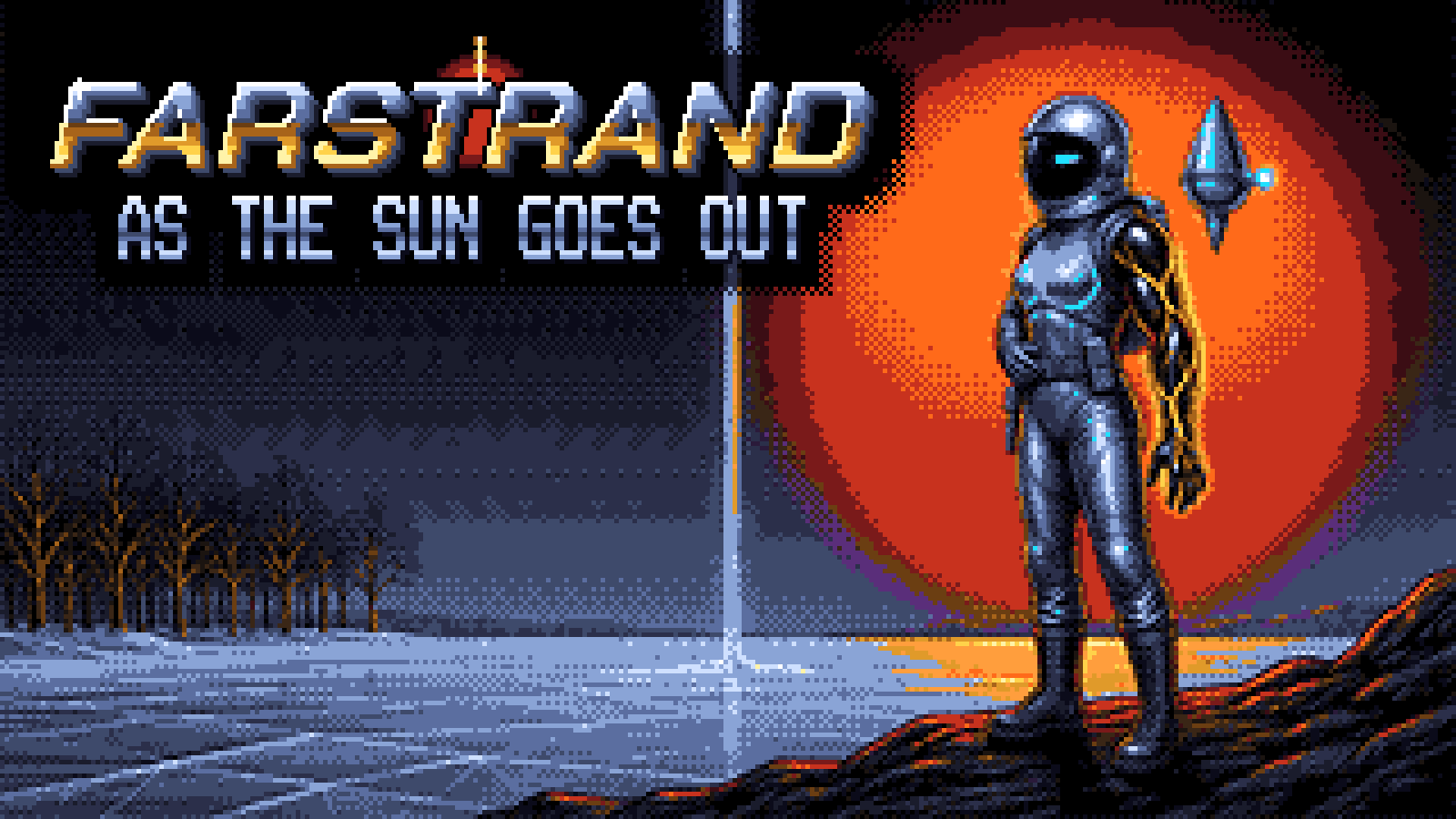
Everybody draws a map in a metroidvania. But hardly any game tries to make the map the story itself, and if you ask me that's exactly what FARSTRAND is going for.
Fact sheet
- Platform
- Windows, macOS, Linux, Steam Deckfree demo on Steam, Amiga demo on itch.io
- Developer
- GandTokyo
- Publisher
- Gand
- Genre
- metroidvania
- Turkish
- Turkish text unconfirmed
Spoiler warning: The section headed "Spoiler" gives away the story the game hasn't revealed yet. If you don't want it, skip that section.
Everybody draws a map in a metroidvania. But hardly any game tries to make the map the story itself, and if you ask me that's exactly what FARSTRAND is going for. The game isn't out yet. The Steam page says "Coming soon" and there's no price either. So I built this piece on the developer's own design documents, world notes and dev logs, because nobody has played the game for this magazine. Meanwhile, a free demo came out on Steam on 27 October. It runs on Windows, macOS and Linux, plays the first world, Halm, from start to finish, and keeps its own save.
First, the plot. HELIOBANE, the first game from Gand, an independent studio in Tokyo, was a shoot 'em up. FARSTRAND is set in the same universe, seven years later. The star called Aurel is about to go out, and the Concord has roughly a century left to evacuate its worlds. There's only one way between the stars: the "strands" that the Umbrine hive, which lives in stars, has woven from sun to sun. Those roads have now frozen solid and turned to glass. Six survey teams have set out, and not one came back. The seventh, the Plumbline, comes down on Halm. And you are Hesper Lind, the ship's cartographer. You wake up in a cocoon of glass in a forest of glass. Your left arm is gone from the shoulder, and in its place is an arm of black glass shot through with gold veins. (Never played HELIOBANE? Not a problem. The game tells you so outright.)
The arm, the heat and the glass
This arm is the backbone of the game. Hesper calls it AŞI. The hive's material, the flesh, comes in three states: sun-fed, meaning hot; flesh, meaning warm; glass, meaning cold. SÖNDÜR pulls one step of heat out and hands it to the arm, and TUTUŞTUR puts it back. Kindle something that's already red-hot and it blows up. Stand right at the foot of the blast and it launches you upward, but you pay for that jump with a bit of your health. A quenched enemy freezes stiff for five seconds. In that time you can climb on top of it, and it takes triple damage from kinetic hits. Kindle the buds and a stalk of flesh stretches out over the void. Quench it before it wilts and you've got yourself a bridge of glass.
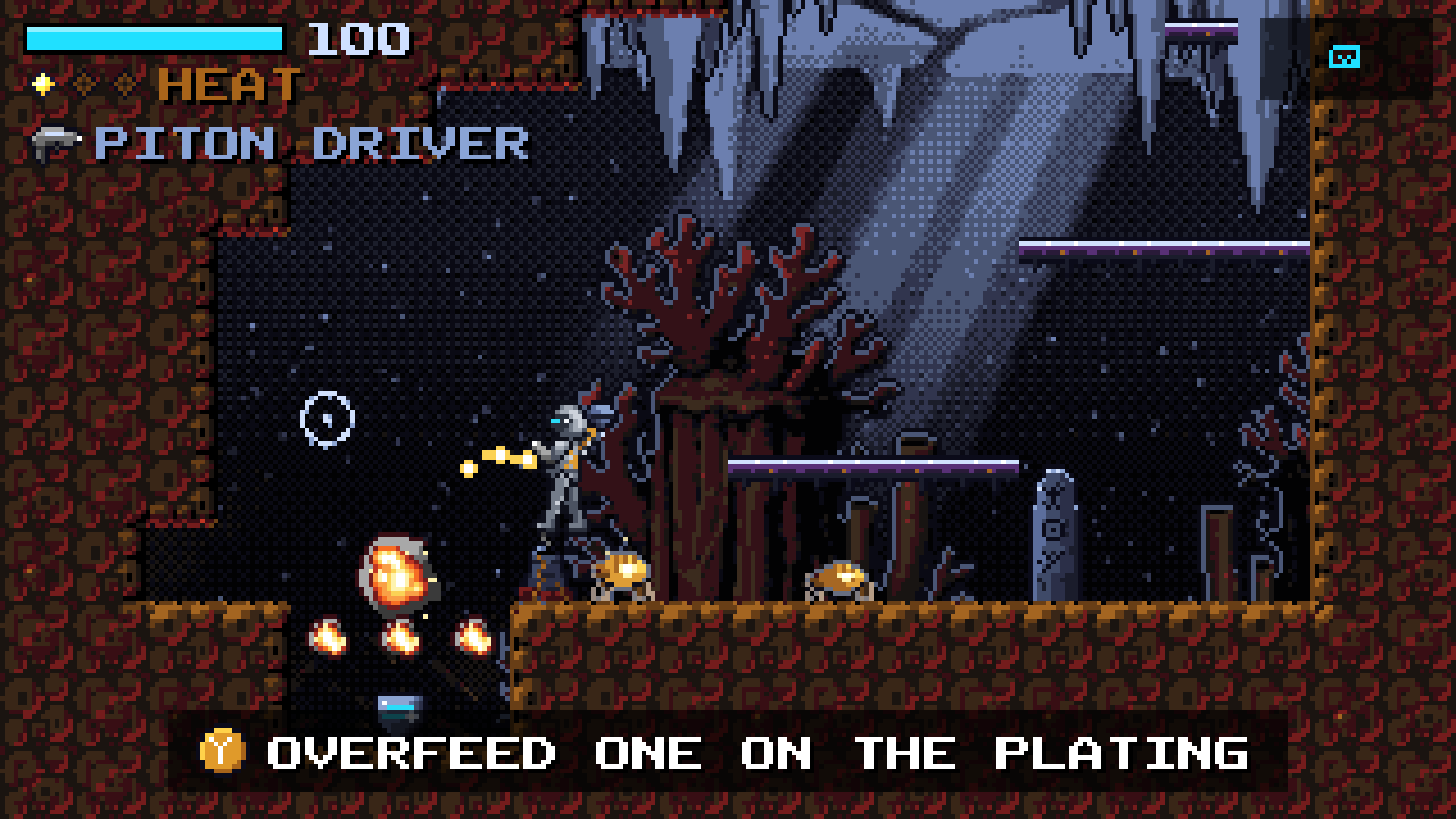
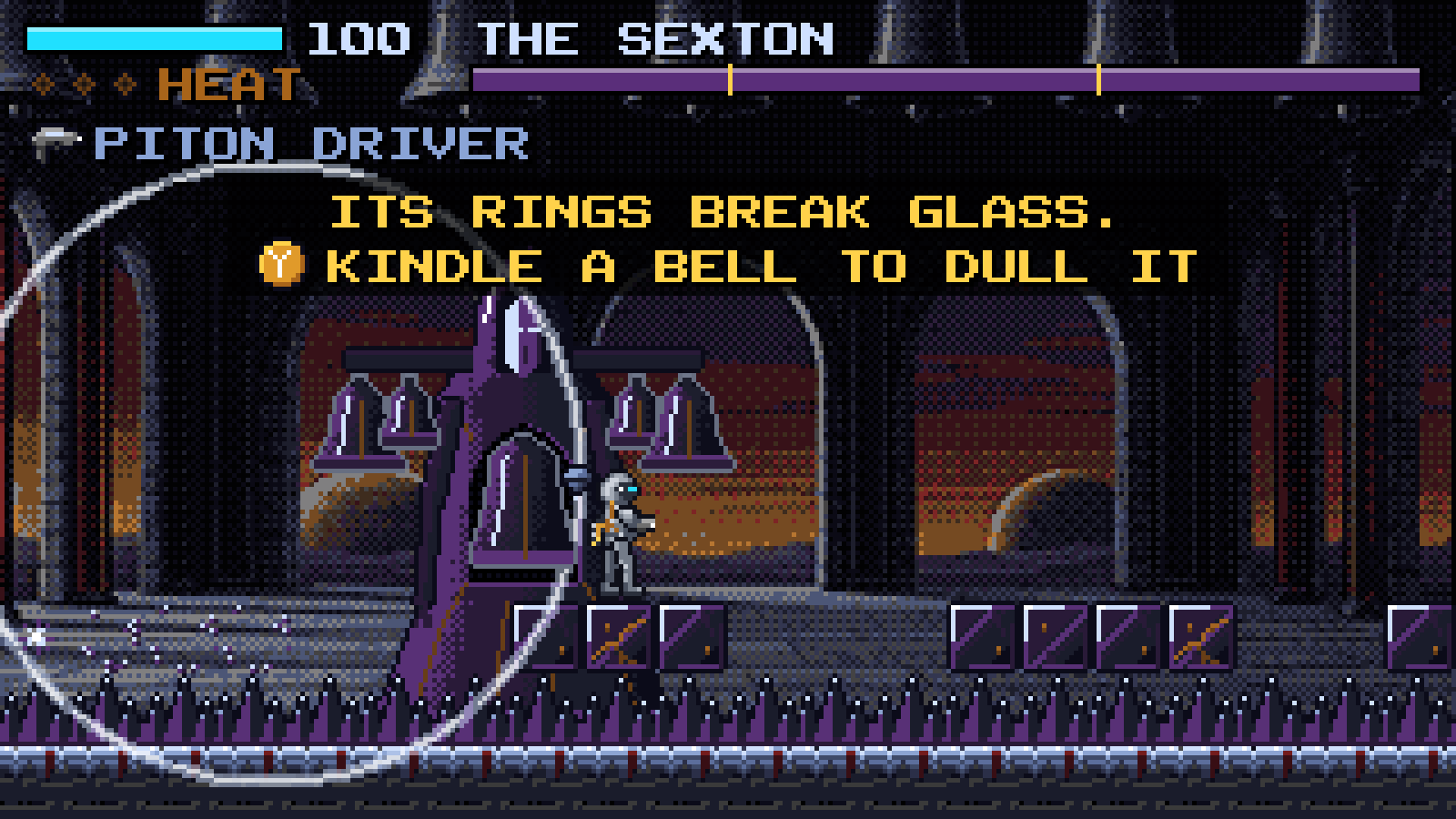
The weapons are hooked onto the same ladder. Glass couldn't care less about bullets ("tink", off they bounce) but takes one and a half times the damage from beams. Red-hot flesh does the exact opposite. So the moment you change an enemy's material with the arm, the right weapon changes too. In the documents the weapon count has gone down from twelve to nine. And the rule is this: every weapon gets a specific place in the game where it's useful. Even the ones you buy from the shop open a stash no other weapon can. If you ask me this is the game's soundest idea: one single verb solves the path, the fighting and the bosses.
But the documents themselves tell you the other side of the coin. The design review says the heat ladder has one single best line in combat: quench first, then hit it with the Piton. The proposed fix, that a full arm can't quench, is still waiting on a decision. If a deep system boils down to one rote routine, the depth doesn't count for much... This is the first place players will poke at when the game comes out.
Pencil and ink
The way the map works is really super. When you walk into a room, it gets drawn onto the map in pencil. When you rest at a beacon, it's made permanent in ink. Die, and only the pencil you drew since your last rest gets erased. Items, opened doors and money stay put. And the map percentage only counts ink. So the price of dying is tied to memory, not punishment. Why it works that way, the story explains later.
They've put the hints inside the world too. There are old marks scratched into the glass: an arrow means the path goes on, a cross means dead end, a line through the arrow means "I need something I don't have yet". In one spot it flat out says "NOTHING HERE. SORRY." (you've got to admire the honesty). You can pick how visible these marks are in the settings.
Where I have my doubts is readability. The picture is drawn at 320×180 with 32 colours. On the overview map one tile is one pixel, and cracked rock and fake walls look like plain rock on the map, on purpose. How that reads on a Steam Deck screen, only the players will be able to say.
There's one more piece that carries the story: the field journal. Six short notes in Hesper's own words, sixty words each at most. Depending on the order you visited the worlds in, a different text gets written. This was added later, because when the developer went through the worlds in an unexpected order in their own playthrough, they couldn't answer "who are these people, what are they doing here, what are we doing here". I liked that honesty. Still, somebody has to ask: a game whose story is told in short text boxes, sixty-word notes and inscriptions you decipher bit by bit, with a hero who's never voiced... how well does that flow in so few pixels?
Difficulty, balance and testing
They've put a fair bit of thought into the difficulty side. Story, Normal and Hard can be switched at any moment. Four assists can be turned on and off one by one (Story means all of them on at once). Hard brings in a real rule: enemies don't drop health pieces. Every world gets its own damage multiplier. The maths is set up so that on Normal you die in about eight hits in every world. The economy is tuned so that a player going for 100% never spends a single minute grinding for money. The developer also built a "boss lab" that sweeps the bosses with a virtual player who plays badly on purpose. That lab closed the safe spots where Gantry and Sexton just stood in a corner and went down easy.
The same documents deliver the bad news too. By the developer's own note, the hardest boss was the first boss. The lab clocks the root phase of the final boss as the calmest fight in the game (5.6 hits per minute, against 7.2 for the first boss) and notes that it most likely needs a new attack. A player who never collected any health plates is gone in four or five hits on Normal in the last region. The documents say this is the thing to watch in the first human playtest.
My real question, though, is how much it has been tested. It was made in a quick fashion, and its scope isn't small: eight regions (one of them secret), around 260 map cells and nine bosses. The Steam page says the visual and audio assets were made with AI tools, and that the code got AI help as well. The testing side is serious: gameplay is deterministic, recorded button inputs get replayed from start to finish, there are around 1,790 tests. But the only recorded human playthrough is the developer's own. And the 6-8 hour length is, in the documents' own words, a target, not a measurement. The virtual player's required route takes 45.7 minutes. I'd say don't buy it without knowing that.
Then there's the Amiga side. A separate AGA Amiga version of the game is being made, and its free demo, which only has Halm, is out on itch.io. It runs at 50 frames on fast Amigas and 25 on an A1200. Its page used to say nobody had run it on a real Amiga. Then a player reported in the comments that it runs without a hitch on a 25 MHz A4000/030. For now, the entire public reaction is the three short comments under this demo. No Steam reviews, no press coverage, and the PC demo isn't open yet. The music was written in a tracker, and the effects are made to sound like Paula's 8-bit audio. There's Turkish text, and the terms were picked with care: DÜĞÜM, İLİK, DOKUZUNCU IŞIK, Mott calling Hesper "evlat"... The Turkish voice-over looks finished in the logs, but the store page doesn't say so yet.
Spoiler
The marks scratched into the glass on Halm are in Hesper's own handwriting. The Plumbline came down three years ago, and Hesper died in that crash. The hive keeps growing her again from the mould it took when it first swallowed her, and every copy thinks it's waking up on the day of the crash. On Carcanet, a machine mind that has counted everything on the planet answers Hesper's "What about me?" with "Which time?", and then says 41. In the ship's stern there are forty notches scratched into the bulkhead, and in the seat sits her own body, turned to glass, the map case in its lap. The beacons are actually cocoons. That's why dying is free, and why pencil only turns to ink there. If you ask me, this spot where the mechanics and the story are tied so tight is the front-runner for the game's strongest moment.
The bad guy is Josef Kell, commander of Survey One. He died, got grown back, figured out what was going on and chose to go along with the hive. His plan isn't stupid: migrating along the cold roads takes a century, along heated ones less than ten years. But every world he heats wakes a Herald. The people of the Ninth Light made that bargain long ago and lost their sun. The final boss is Kell grown into the root. The fight turns into a vertical shoot 'em up where you fall down the strand into the sun's corona, shooting downward (a clear nod to HELIOBANE). And in İLİK waits the nineteenth Hesper, the one who said yes to Kell's offer. She fights with your weapons and your arm, quenching and kindling the floor under your feet. In the end Hesper quenches the root and is left with a slow but safe cold road out of Aurel. Mott finally asks about the map, and Hesper says she has forty-one of them. After the credits there's also a short final scene that unlocks for 100% map and the secret boss. That one I'm not telling.
Verdict
FARSTRAND as it reads in the documents is an ambitious, honest design that tries to run one single idea through the map, the fighting and the story all at once. It has written down its own weak spot too: until the demo came out, nobody but its developer had played it. Download the Steam demo and go have a look at Halm, no question. Before you buy the full game, wait to hear what the first players say about the difficulty curve and how readable the map is. And write to us with what you find...
Disclosure: Farstrand and Heliobane are this magazine's editor's own projects.
Sources
- Primary source farstrand.gand.games
- Press kit farstrand.gand.games
RETRO page · FARSTRANDIssue 02 · October 2026