Hardware · retro · fpga
Analogue Super Nt+ and Mega Sg+: A New Shell for the Old Cartridge
Towards the end of October the evenings suddenly get shorter. The hour when you were sitting on the balcony only last week is the hour you have to switch the lamp on today. No, I'm not trying to make anyone miserable; when the air cools, you just want to shut yourself in at home, that's all there is to it. The wind piles yellow leaves along the edge of the pavement, the teapot never leaves the stove, and you draw pointless shapes with your finger in the fog on the window. Outside there's rain, inside there's the tick-tick of the radiator, and it isn't even seven o'clock yet. The real job on evenings like these is getting the cartridge box down from the top shelf of the cupboard.
This month I'll be telling you about the two new consoles Analogue announced on 16 October 2026: the Super Nt+ and the Mega Sg+. Let me say this up front: the units haven't shipped yet, and we don't have a box in our hands. This piece is based on the manufacturer's product pages and the news that came out after the announcement. Owners have nothing to report yet, either.
First, a little history
If you remember, Analogue got into this business in 2017 with the Super Nt. The Super Nt was a console that played SNES and Super Famicom cartridges. Then in 2018 came the Mega Sg, for Genesis, Mega Drive and Master System cartridges. Production of both ended in 2022 with a final batch; in that final batch the price was 199 dollars. So the new models with the plus sign are the return of two machines that had gone off the market.
The new price is 219.99 dollars each. A 21-dollar difference won't surprise anyone, given four years of inflation. But the originals came with a game in the box (Super Turrican Director's Cut with the Super Nt, Ultracore with the Mega Sg). The new ones have no such gift. Don't forget that when you do your sums.
What an FPGA is, and what it isn't
Before we get into it, a quick word on terms. Both consoles are built on an Altera Cyclone V FPGA (Field Programmable Gate Array, that is, a gate array you can program in the field). In an emulator, a program guesses what the old machine would do and imitates it, like an actor playing a patient. In an FPGA, though, the logic gates inside the chip are wired up to copy the old machine's circuit. It isn't an actor doing an impression, it's a transplanted organ. Analogue says it wrote these cores itself and that there's no emulation anywhere in sight.
Commentators in the press and on the forums say the new models use the same FPGA. The official page only says Cyclone V; read "the same chip" as an observation, not as hard fact. The practical meaning of this detail is this: the heart that runs the games hasn't changed. The shell around it, the inputs and outputs and the software have been renewed.
What's new?
Now to the changes. I'll list what's on Analogue's pages, item by item:
- Wireless connection: Built-in Bluetooth and a 2.4 GHz receiver let you play wirelessly with up to two controllers. The compatible controllers are 8BitDo's SN30 and M30 models. These are sold separately, at 29.99 dollars each.
- USB-C power input: Replaces the micro-USB on the originals. A 30 W GaN adapter with USB-C PD 3.0 support comes in the box (US/Japan plug).
- USB-A output: Only serves to power Analogue's separately sold DAC or to charge controllers. It carries no data.
- Pairing button and two player LEDs: Used to introduce the wireless controllers to the console.
- Power-on from the controller: Lets you wake the console with a button on the controller without getting up off the sofa.
- Startup actions: Determines, for example, that the console boots straight from the cartridge without stopping at the menu.
- Cartridge swapping from the menu: Lets you pull the cartridge out and plug a new one in without switching the console off (hot-swap).
- Custom menu fonts: Used to personalise the look of the interface.
On top of these come a new industrial design, a renewed operating system and new packaging. The original wired controller ports stay right where they were; your old SNES or Genesis controller isn't headed for the bin.
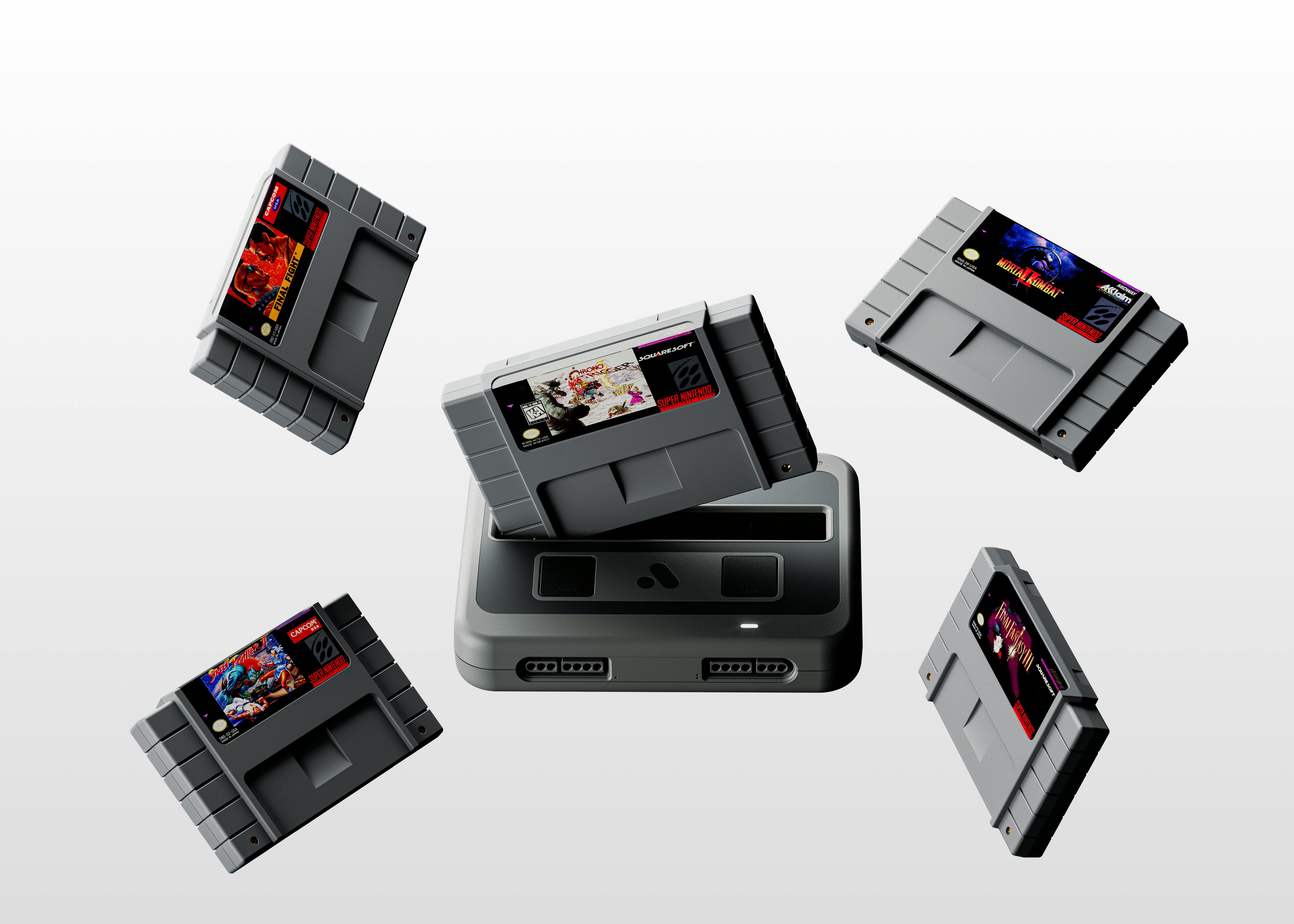
I have to issue a warning, because it's obvious there'll be a misunderstanding about this: DON'T EXPECT TO PLUG A WIRED USB CONTROLLER INTO THE USB-A PORT AND PLAY!!! That port is a power socket, not a doorway. If you want to play wired, you'll use the original controller ports.
Picture and sound
Output is HDMI only. NTSC games can be output at 480p, 720p and 1080p, PAL games at 576p, 720p and 1080p. No 4K. The aspect ratio can be chosen between 8:7, 4:3 and 1:1. For those who want to soften the pixels there are filters from HQ2x up to HQ4x; for those pining for a tube television there are normal and hybrid scanline options. Cropping the picture at the edges is possible too. Sound comes over HDMI at 48 kHz/16-bit.
The consoles are region free and can switch between NTSC and PAL. Those of you who used to file down the plastic tab on the back of a Japanese cartridge to jam it into a European console, read that sentence twice. There's also an SD card slot formatted FAT16/32.
What's missing?
Analogue has listed the shortcomings openly on its own page, and I respect that. The list goes like this:
No openFPGA support. That was the framework on Analogue's handheld, the Pocket, that let it run cores written by the community. Here the door is shut; the console runs only Analogue's own cores. There's no save state and no overclocking. You can't take screenshots. The feature the company calls "Memories" isn't on these machines either.
Pieces written after the announcement added three more gaps: no Wi-Fi, no built-in DAC, no 4K. Some writers point out that the Analogue 3D, a more capable Analogue console, sells for less than these two put together. The comparison isn't unfair. What makes the Super Nt+ and Mega Sg+ look expensive isn't the price itself, it's the other box in the same company's shop window.
Compatibility: a bit of a numbers game
The figure given for the Super Nt+ is more than 2,200 SNES and Super Famicom games. With the Mega Sg+ things get a bit muddled: Analogue's page says "more than 2,180" in the text and "more than 2,200" in the spec table. Both numbers come from the manufacturer. Which one is right, the lists owners keep once the shipments go out will tell.
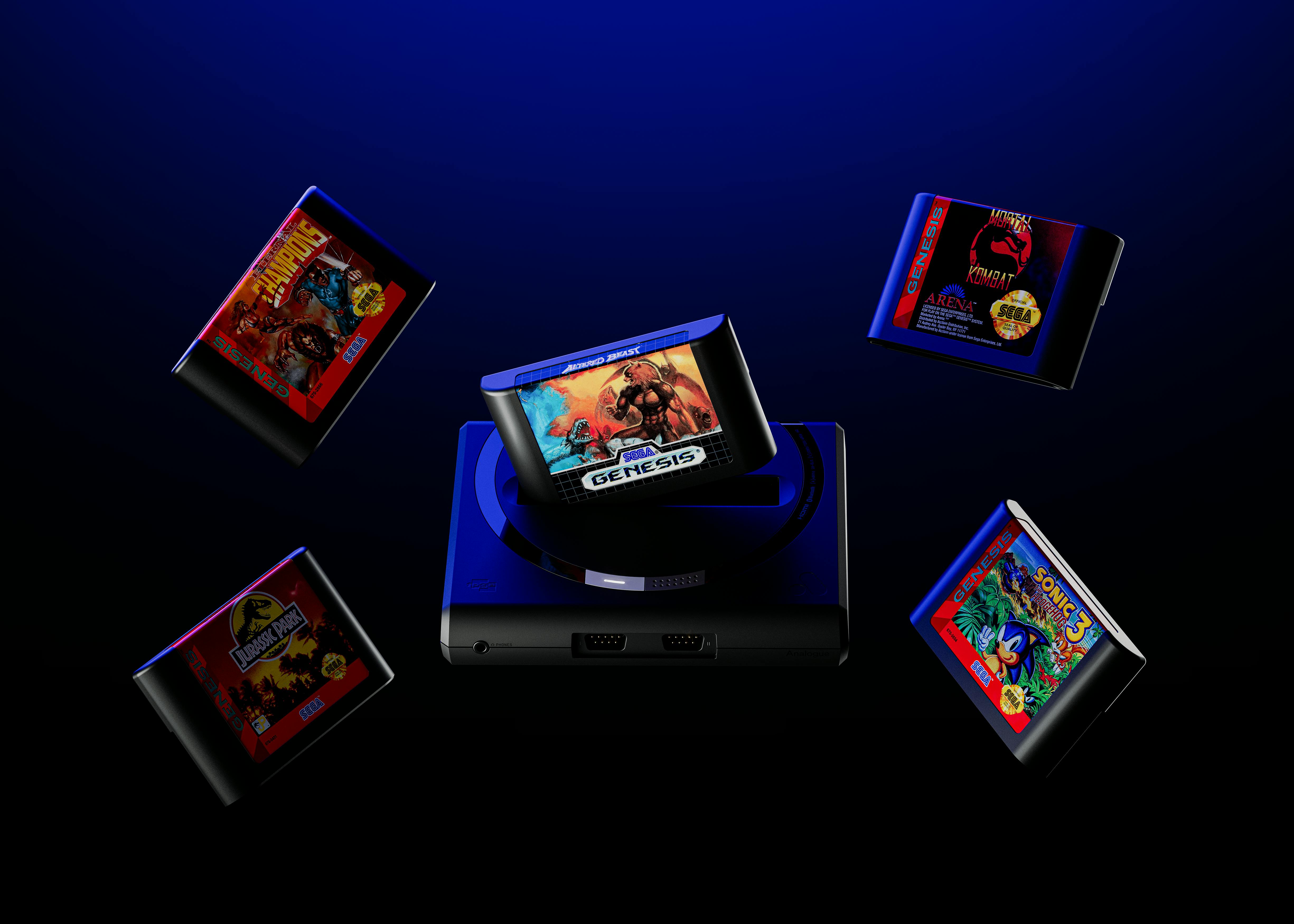
The Mega Sg+ isn't limited to Genesis and Mega Drive. Master System cartridges play directly with the adapter in the box. Game Gear, My Card, Mark III and SG-1000/SC-3000 need separately sold adapters. There's Sega CD/Mega CD support too, but let's attach a condition here as well: YOU NEED TO OWN A REAL SEGA CD UNIT. The console connects to that unit through the expansion port of the original design; it doesn't read CDs itself. The Sega CD spacer in the box is for exactly that.
The box contents are the same for both consoles: the console, an HDMI cable, a USB-C cable, the power adapter and two cartridge cleaners. I liked that last item. The company is gently warning the generation that thought it could fix contact problems by blowing into the cartridge (that is, all of us): damp breath doesn't clean contacts, it corrodes them. The dimensions are as follows: Super Nt+ 5.2 × 6.5 × 1.6 inches, Mega Sg+ 6.6 × 5.4 × 1.8 inches.
The pre-order saga
Pre-orders opened on Monday 19 October at 08:00 (Pacific time; in Japan not the midnight between 20 and 21 October, but 20 October 00:00). The Super Nt+ went on sale in Classic, SF and Black; the Mega Sg+ in USA, EU and JP. The colours are the same as the originals. Today both product pages say "Out of Stock". According to a report on a site called Max Frequency, all six of the six models sold out within a few hours. Analogue, for its part, has neither made a statement on this nor announced new stock. So "they all went in hours" is, for now, one news site's observation, not the company's word. For delivery, the pages say "December 2026"; the exact date will be announced later.
So who is it for?
Let me give my verdict up front: the Super Nt+ and Mega Sg+ aren't something new, they're a polished version of something well known. Most of the pieces written after the announcement reached the same conclusion; they call it an "improvement", not a "redesign".
My advice to the reader who already owns an original Super Nt or Mega Sg is to ask themselves one single question before paying for these boxes: are a wireless controller and a USB-C power input worth 219.99 dollars? There's no official word that the core running the games has changed. The picture options, cartridge compatibility and the ceiling of the HDMI output sit in the same place on paper. What's changed is the console's life in the living room: switching it on without getting up from the sofa, playing without tangled cables, going to the cartridge without stopping at the menu. These are nice things, but they're not a reason to upgrade.
For those who missed the final batch in 2022, though, it's a different story. For someone with a cartridge collection who wants to play it on today's television with no lag and a clean picture, there's no tidier solution in sight on the market than these two boxes. No rose without thorns: no 4K, no save states, and no laying hands on the cores from outside. None of these is a wrong decision, but all of them have been left out on purpose. Buy it knowing you're buying a closed system.
I have one more reservation. This whole piece is built on paper. The answers to the real questions (heat, build quality, software bugs, the latency of the wireless connection) will come after the boxes reach their owners. In December, once the shipments go out and the first complaints and the first praise hit the forums, the picture will need reading again.
Yes, that's the story of the two consoles for now. If stock opens up again, what you do is up to you. The teapot is still on the stove and the cartridge box is down from the shelf; I'm pouring myself a glass, you pour one too. Until we meet again in December when the boxes are opened, goodbye.
Sources
- Primary source analogue.co
- Press kit analogue.co