Hardware · handheld · retro
Evercade Nexus
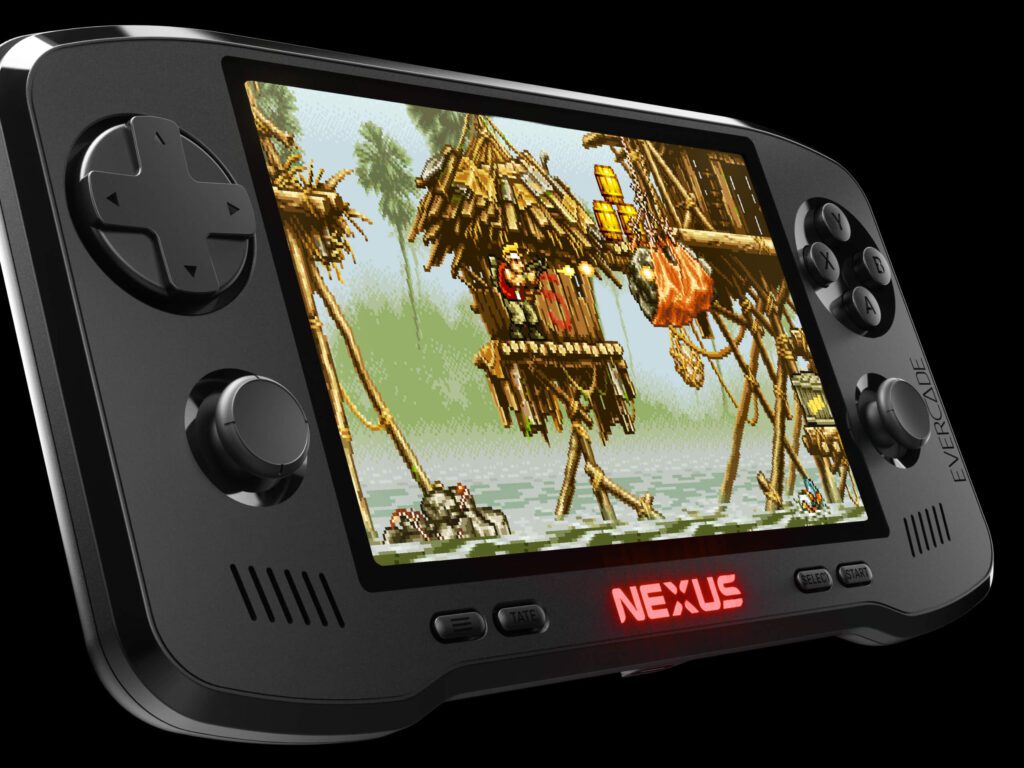
Hello.. Some sit down with a book in their hands, some with their knitting needles. And some of us go hunting for a gadget with a light that glows, buttons to press and a slot for a plastic cartridge. So do you need an excuse to sit down with something in your hands? You do, and once a good excuse turns up, your mind is at ease as well: the lamp goes on, the cartridge settles into its slot, the first button gets pressed. (I'm not offering this to anyone as an alibi!) Shutting yourself in at home may sound gloomy. No, this is not a melancholy piece. Long hours at home have their good side too, and that's what I'm here to tell you about.
In this issue I'll be telling you about the Evercade Nexus, which hits the shelves on 30 October 2026. Let me say it up front: we don't have a unit. This piece rests on Blaze Entertainment's official specifications and on reviews written with test units sent to the press in advance. Nobody has bought one yet, so there are no owners' accounts either.
What comes out of the box
The Nexus is made by Blaze Entertainment in the English town of Letchworth. The company announced the device on 31 March 2026 and opened pre-orders the next day. It costs £169.99, $199.99 or €199.99. Out of the box come the console itself, the Banjo-Kazooie Double Pack cartridge, a USB-C to USB-A cable and a short quick-start guide. No adapter, no case. So if you want to charge it from the wall socket, you'll have to fish one of the old phone adapters out of the drawer (any one that gives 5V 2A will do).
Let's go through the specs one by one:
- Screen: 5.89-inch IPS, 840×512 resolution, brightness above 500 nits.
- Processor: 1.5 GHz quad-core; memory 512 MB.
- Battery: 5000 mAh, good for more than 5 hours according to the maker.
- Size and weight: 215×111×34 mm, 410 grams, colour black.
- Connectivity: Wi-Fi 6 for updates, Bluetooth for wireless headphones, a 3.5 mm headphone jack.
- Sound: stereo speakers on the front.
- Extras: a glowing RGB logo, and a TATE mode for using the screen vertically.
- Video output: none. It doesn't connect to a television.
There's a small inconsistency as well. Blaze's August press release gives the screen as "5.3 inches". The official page says 5.89 inches, and the reviews that measured the device back the official page. Whoever wrote the press release seems to have been looking at an old draft.
Two sticks, for the first time
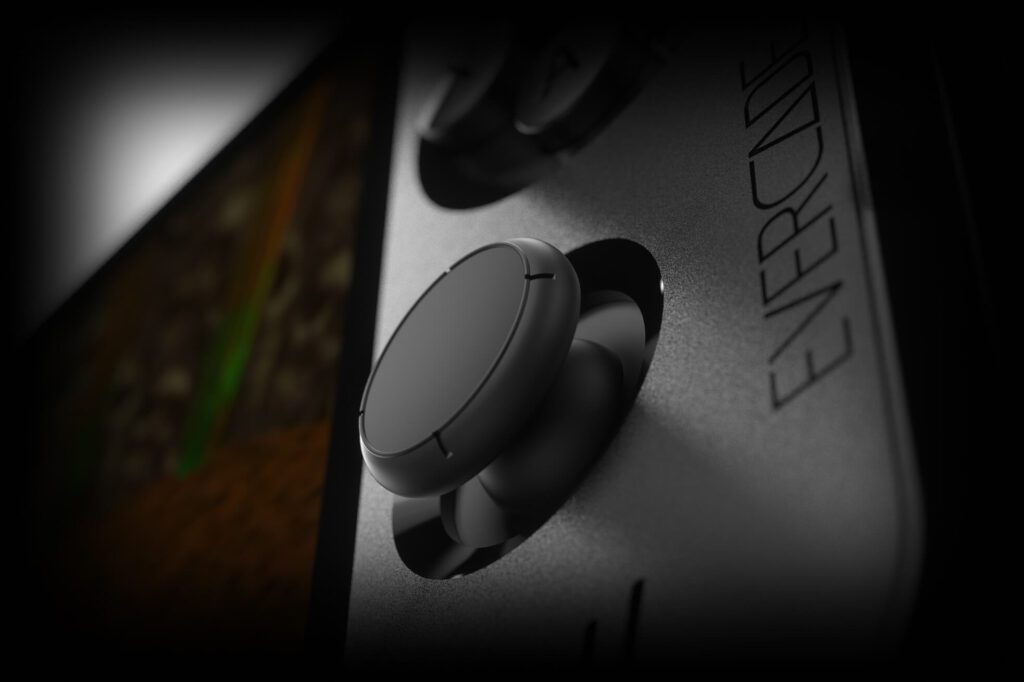
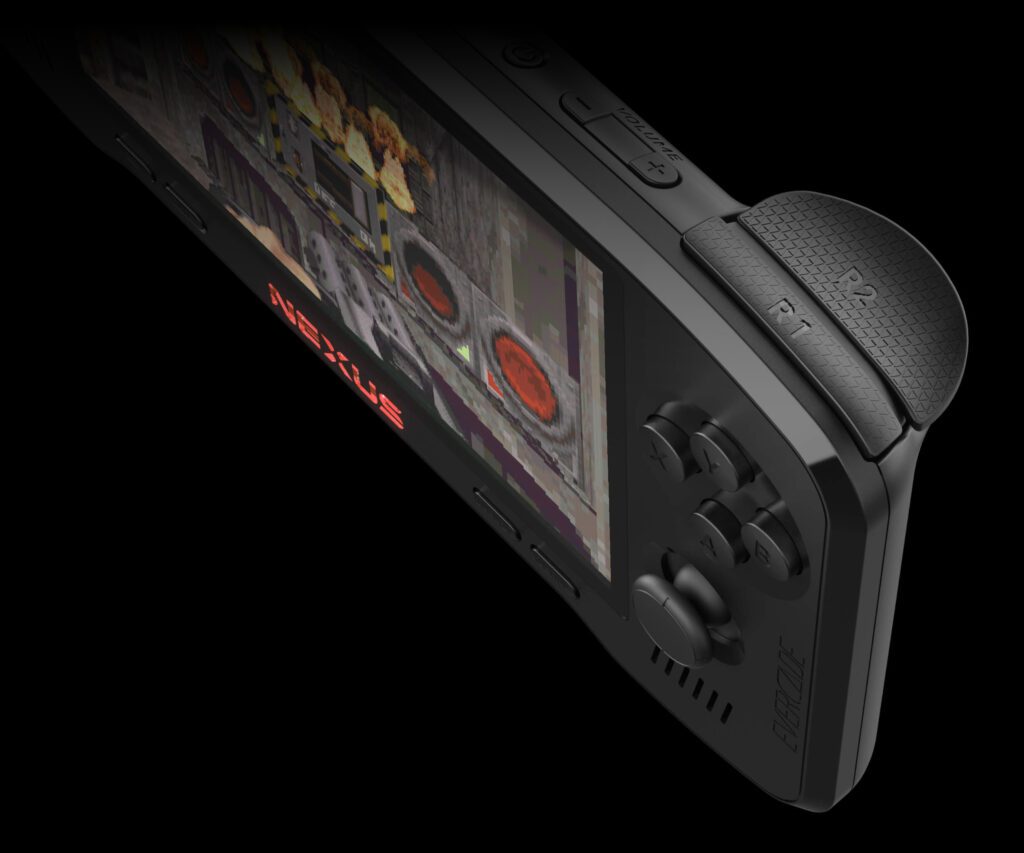
What really sets the Nexus apart from the earlier Evercades is the controls. This is the brand's first device with twin analogue sticks (dual analogue sticks). Press down on the sticks and L3 and R3 work too. On top of those come a D-pad, face buttons, and shoulder buttons and triggers on the back.
So why now? The answer is in the cartridge in the box. Until now the Evercade library was mostly games from the 8- and 16-bit era, and a D-pad was all they needed. In a three-dimensional game, though, you can't turn the camera without a second stick.
The reviews all say the same thing about these sticks: they're small and their travel is short. More importantly, they sit low on the body. So in long sessions you have to curl your hand into a claw (claw grip). The device is bulky to start with. There are no grips on the back, and the shiny corners dig into your palm. Several reviews note, each on their own, that this wears the hand out over long sessions. The shoulder buttons are noisy. The D-pad, on the other hand, is reckoned the best Blaze has made to date. Since the D-pad is the real button of old-school games, that's no small compliment.
The bear and the bird in the cartridge
The Banjo-Kazooie Double Pack in the box is this device's shop window. Inside are Banjo-Kazooie and Banjo-Tooie. Neither is N64 emulation: both are native ports built from Rare's source code (native port, that is, the game recompiled directly for this device). The official list promises widescreen, a reworked camera driven with the two sticks, D-pad support and unlockable extra content.
On frame rate you have to tread carefully. Reviews that tried the device, VGC and GameXplain among them, say the games run at 60 frames per second. The official product page gives no frame rate at all. These ports also run on the older Evercade devices. According to second-hand sources, 60 frames is only on the Nexus, Alpha and Super Pocket models, but no first-hand source confirms it.
There's a gap too. According to GameXplain, the note and Jinjo saving from the Xbox versions (collected notes and Jinjos not resetting when you die) didn't make it into these ports. Those who know the game inside out, consider yourselves warned: you'll be trudging round the same level more than once because of it.
DOOM comes too, separately
On the same day, 30 October, red cartridge number 11, The DOOM Collection, comes out as well. It's sold separately, at £24.99, $29.99 or €29.99. Inside are DOOM, DOOM II, TNT: Evilution, The Plutonia Experiment, Master Levels, No Rest for the Living, SIGIL, SIGIL II and a Deathmatch map pack. For a single cartridge, that's a very generous haul.
The extras go like this: widescreen, three different music arrangements, and modifiers you'll only find on Evercade (Turbo, double monsters, Vampire mode and so on). New multiplayer modes called Chaosmatch, Instagib and Tag have been added too. The press release talks about high resolution and a smooth frame rate. Second-hand reports call these native ports, but read that as someone's interpretation, not as something the release spells out. The cartridge runs on every Evercade device and on the HyperMegaTech! Super Pocket.
For collectors there are also two limited editions sold only through Funstock. The 2,000-unit Nexus 64 Edition (£189.99 or $229.99) is long gone. The 3,000-unit Nexus DOOM Edition costs £199.99, $249.99 or €239.99. Its box holds a big-box DOOM cartridge, a case, a comic, a poster and a certificate. Pre-orders opened on 7 August, and it too ships on 30 October.
Old cartridges and EverSync
The Nexus runs the entire existing Evercade library. Blaze's figure is more than 80 cartridges and more than 700 games. VGC's count is about 90 cartridges and 750 games. The gap between the two most likely comes down to when the counting was done. Whichever you go by, the old cartridges on your shelf don't go to waste. Every one of them is a real, physical cartridge, not an account-bound digital library (in other words, a shelf you rent). Your cartridge is yours whenever you want it. That, to my mind, is the soundest thing about this brand.
EverSync, meanwhile, lets you link two Nexus units wirelessly and play together in the same room, and a single cartridge is enough for it. No review could try it, though, because nobody had a second device. So for now the only thing anyone can say about this feature is that it exists on paper.
Diagnosis: chronic insomnia
What the reviews grumble about most is speed. By VGC's measurement the device takes about 42 seconds to reach the main menu. On top of that you wait roughly another 20 seconds for Banjo to load. That's close to a minute. Not long enough to brew a Turkish coffee, but long enough to put the pot on the stove and measure out the water. (The coffee itself I leave to you.)
The real trouble, though, is that there's no sleep mode. Let's write it up in the patient's file:
Symptom: You can't stop the game halfway and close the lid... Diagnosis: The device doesn't know how to sleep; it's either on or off. Treatment: None for now. A software update is hoped for, but Blaze hasn't promised one.
In practice this means that when you have to put the game down, you either save, switch off and then sit through the one-minute boot all over again, or you leave the device on and take your chances with the battery. In a games machine meant for the pocket, that's a serious hole. Put a one-minute boot together with no sleep mode, and the moments when you say "I'll just play for five minutes" take the worst of it.
On battery, the reviews mostly back the maker. VGC and Pocket Tactics got about 5 hours (Pocket Tactics checked it over two separate charges). Tom's Guide's measurement comes closer to 4 hours. Only one bug was reported, and a small one: according to Retro Handhelds, when you switch off, the screen goes dark a few seconds before the sound does. No review mentions it running hot.
So, do you buy it?
The good side first. The screen is bright and wide. The speakers are louder than on the earlier devices. The D-pad is excellent. The two Banjo ports in the box are the real deal: not running on an emulator but compiled from source code, widescreen and at 60 frames. Build quality is also judged good for the price. VGC gave the device 4 out of 5, Pocket Tactics 8 out of 10. Retro Handhelds gave no number, but its conclusion was positive.
Then the flaws. 840×512 is a low resolution for a screen this size. No TV output. The body is bulky and the sticks sit low. Slow boot, no sleep mode. And then there's the price: for $200 today you can find emulation handhelds that run a great deal more, and nearly every review makes that comparison.
I think the comparison holds, up to a point. An emulation device gives you an almost bottomless library, but where you get the games and what's legal stays your problem. The Nexus is a system built on licensed cartridges with no copy lock, the kind you line up on a shelf. On top of that you get two ports that came straight out of Rare's source code. If you already have a pile of Evercade cartridges and you've been waiting for a twin-stick device, the Nexus is the one. My advice, all the same, is not to rush. After 30 October the accounts of people who actually bought one will start coming in. Seeing what their hands say after long sessions, and whether an update turns up for sleep mode, is smarter than pre-ordering. If you have no old cartridges and no special soft spot for Banjo or DOOM, look at other devices for the same money too. Which one suits you, you can weigh up for yourself with all this in hand.
Yes, that closes the Nexus file for now. Once I've gathered the owners' first reports, we'll pick up where we left off. Switch on your lamp, and goodbye...
Sources
- Primary source evercade.co.uk