Software and AI · artificial intelligence · large language model
Gemini 4 Argon: A Million-Token Memory, and a Bill That's About to Double
Know what's on the table this month? Of course you don't, unless you've read the headline. Google announced Gemini 4 Argon on 30 September 2026, and on 13 October it threw the doors open to everyone. One thing before we open the file: this piece rests on Google's own announcements, the Gemini API documentation and the press coverage after launch. Nobody ran the model for this magazine. Whenever I say below that it "does" something, that's Google saying it does.
1. First, the numbers
The model ID is gemini-4-argon. According to the docs the context window is 1,048,576 tokens, and input and output share it. If that number rings a bell, it should: 1024 times 1024, exactly the number of bytes in a megabyte. Once we couldn't fit that figure onto a whole floppy. Now we read it as the chunk of text a language model "keeps in mind" in one go. And those aren't bytes, they're tokens. A token is roughly a piece of a word, so the window comes to hundreds of thousands of words. You can shove a novel in at once, with a software project's source code on top.
The real news is on the output side. The default output limit is 65,536 tokens. In the long-generation mode called "long decode", that limit goes all the way up to the full window, 1,048,576 tokens again. By Google's own note, earlier Gemini models topped out at 64K. A model that can pour out a book's worth of text in one session, or enough code to rewrite a module from top to bottom, and keep going without a break: on paper that's quite a leap.
It takes text, images, video, audio and PDF as input. Output is text only. It doesn't make pictures or sound, and it doesn't support the Live API (the real-time voice conversation interface) either. The "thinking" level comes in three settings: low, medium and high. For tools, the docs list function calling, code execution, and checking facts against Search and Maps (grounding). Then there's "computer use": the model looks at the screen and works the mouse and keyboard itself. That one is still in preview.
2. Who, when, and where from?
The rollout came in unusual stages. Argon went first to trusted cyber defenders admitted to Google's Fairwind Program. For that group, and for Google's internal teams, the model ships with its cybersecurity guardrails switched OFF. In other words, the "I can't help with that" brakes everyone else will hit aren't there for them. Google also says it went through the US government's voluntary pre-release model access process for this.
General access opened on 13 October. Developers and companies reach the model through the paid tier of the Gemini API. The listed ways in are Google AI Studio, Android Studio, the Gemini platform, Gemini for business and Google Antigravity. AI Ultra and Pro subscribers find Argon in the Gemini app and in AI Mode in Search. In Antigravity, it's Ultra subscribers only. On the same day, Fairwind grew to take in hundreds of new partners. And there's a nice gesture: 10,000 scientists can apply to use Antigravity's top tier free for six months. Giving science free tools was one of our favourite things back in the day, and it still is.
3. Price: cheap for now, not for long
Price is where Google speaks most plainly in this whole story, so credit where it's due:
- Until 30 November 2026 (launch price): $2 per million input tokens, $10 per million output tokens. Cached input is 95 percent off, which for now works out to 10 cents per million tokens.
- From 1 December: $4 for input, $20 for output.
So a month from now the price DOUBLES. Keep that in mind while you read, because the "$2 / $10" figure doing the rounds is correct but comes with a use-by date. And here's another sum: the model's most praised feature is the million-token output. If one long generation runs up to the ceiling, at the new price the output bill alone hits $20. If you're planning to hand it long jobs, set your budget by the December price, not the launch one. Nobody minds paying for a developer's work. But the announcements don't spend a single sentence on why the price doubles, and to my mind that's a hole.
4. Google's report card (filled in by Google)
On to the benchmarks. Let me shout this up front: ALL the numbers below are numbers Google published itself.
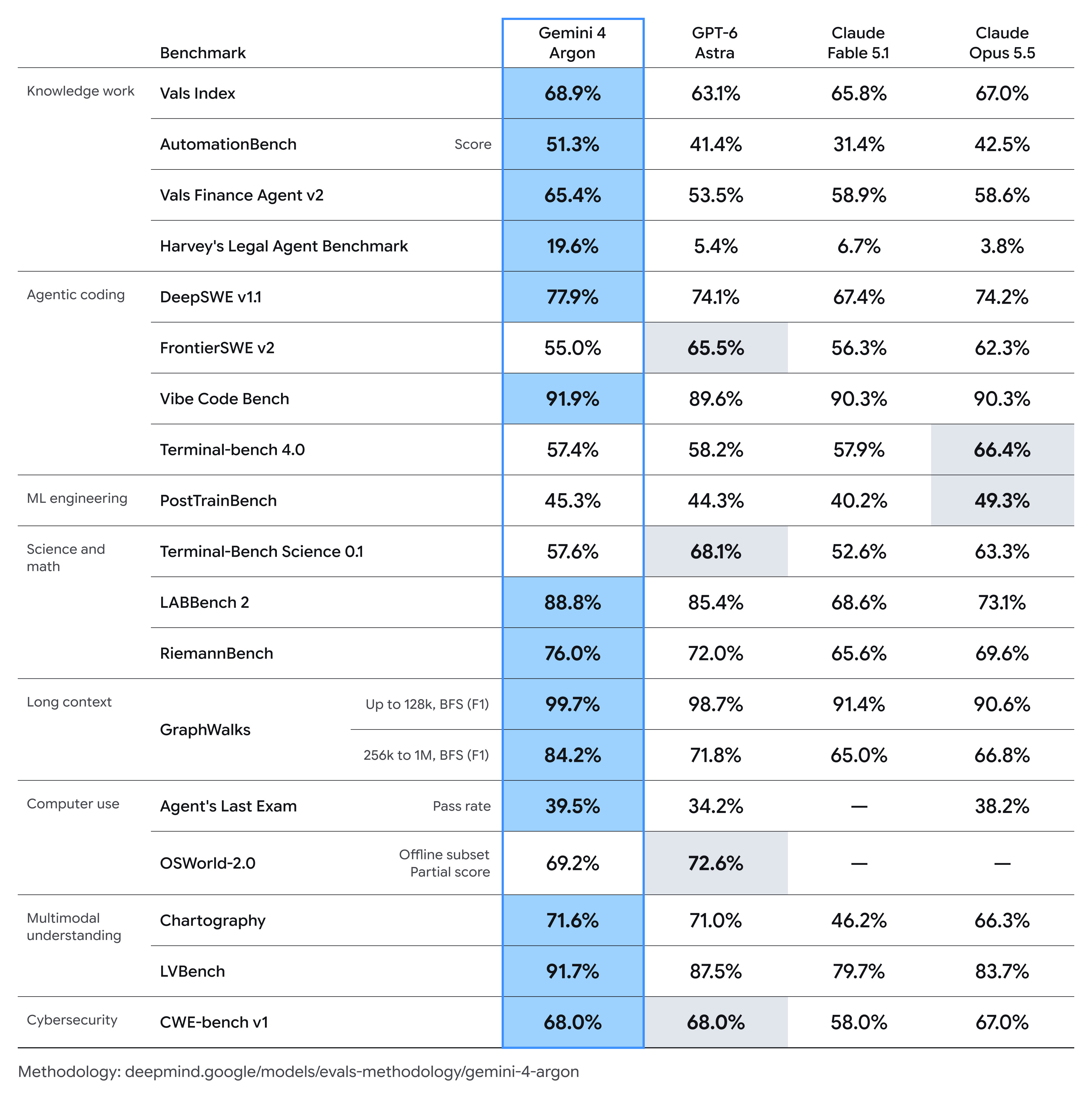
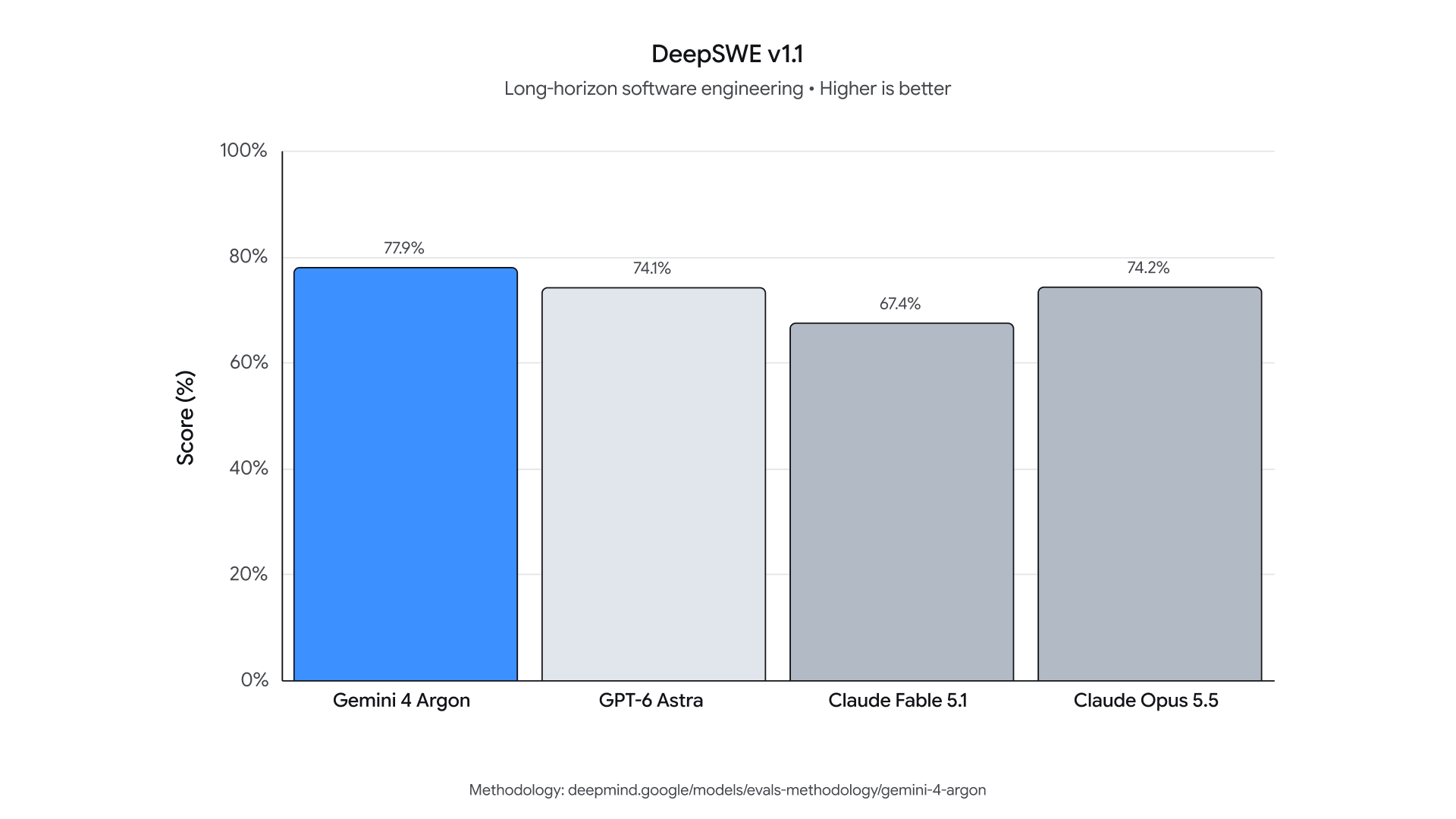
- DeepSWE v1.1: 77.9 percent. Google presents it as the best result in the field. The test measures debugging and fixing work in real software repositories.
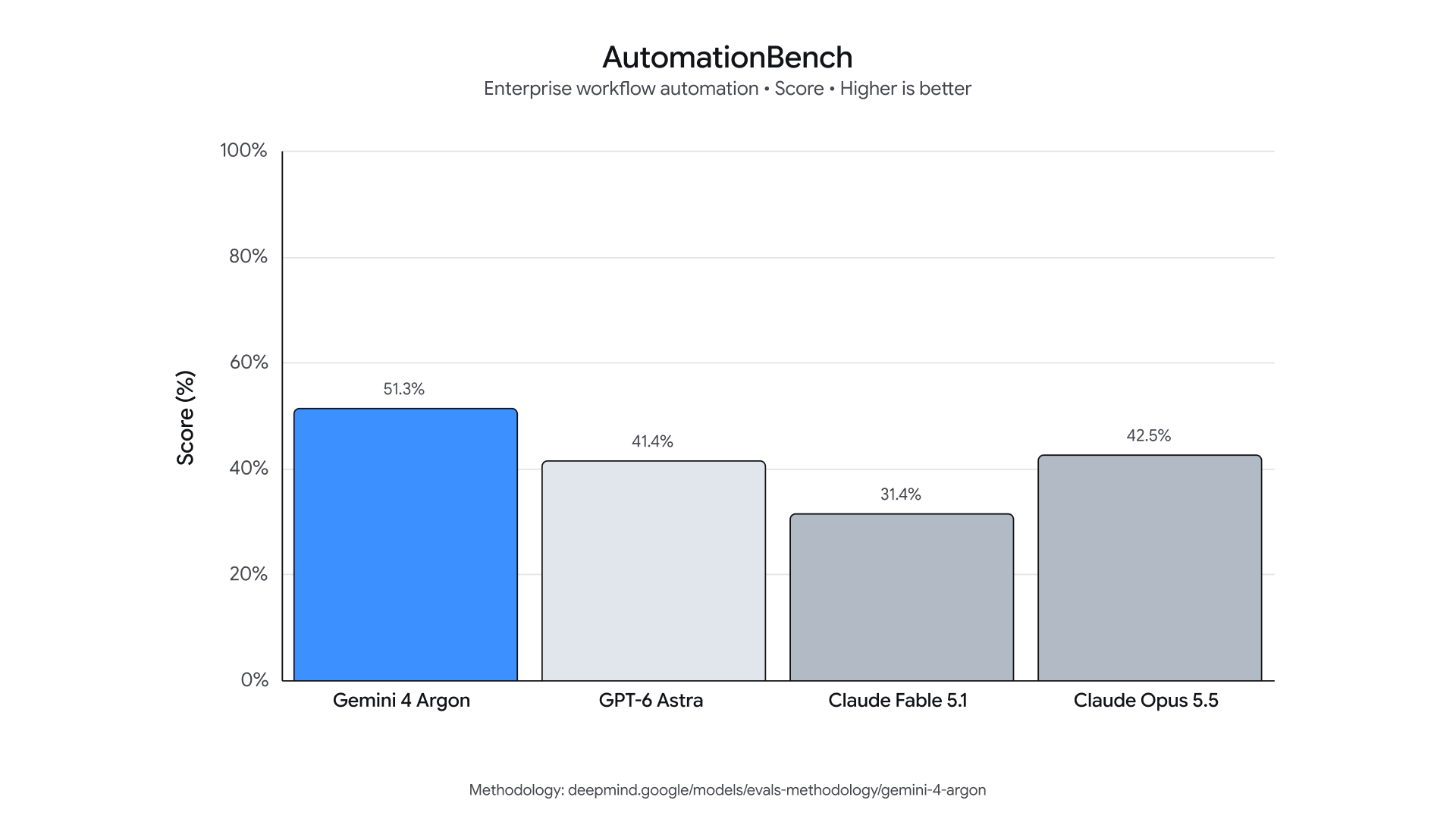
- AutomationBench (Zapier): 51.3 percent, first place. It measures building multi-step automations across apps.
- LVBench: 91.7 percent. A long-video understanding test.
- CWE-bench v1: 68 percent, joint first. It's about fixing security vulnerabilities.
- Vals Index: first. Google also says it leads on Vals Finance Agent v2 and on Harvey's legal agent test, but gives no figures for those two. A first place with no number goes in my notebook as "pending".
- Gray Swan indirect prompt injection test: an attack success rate of 0.7 percent, per the 13 October announcement. Prompt injection means steering a model off course with instructions hidden in a web page or document it reads. In a model that uses a computer on its own, a low rate here isn't decoration, it's a requirement.
Then there's the cybersecurity claim. According to Google, Argon finds critical vulnerabilities on its own, confirms them and patches them. On an internal vulnerability test it reportedly beats Gemini 3.8 Flash Cyber too. As an example, Google says that in Wiz's Scan for Good programme it found a critical flaw in healthcare software that earlier models had missed. It's a striking example, but it comes from Google's own telling, not from an independent audit.
5. How does it look from the outside?
A language model has no Steam page (and if it did, who would write the reviews? That's another question), so what we have is the tech press and independent rankings. According to secondary sources, Artificial Analysis puts Argon level with GPT-6 Astra on its Intelligence Index. We couldn't confirm that ranking on Artificial Analysis's own site, so treat it as reported news.
Two shadows hang over the launch coverage. The first is that on some of Google's own coding comparisons, Argon still trails its rivals. The second is more interesting: Bloomberg reportedly ran a story saying some Google employees found the model weaker on real coding work than the tests suggest. Google disputes this. We haven't seen any of it with our own eyes, but we can't just look the other way either. The gap between a 77.9 percent DeepSWE score and the everyday code on an engineer's desk is exactly the question this file is really about.
(Let me open a bracket here: reports put out by AFP say the launch slipped by months and that Google shelved Gemini 3.5 Pro along the way. Some also talk about management changes at DeepMind. None of this appears in Google's own announcements. Read it as unconfirmed news and don't hang too much on it.)
The praise lands in three places: the million-token output, long multi-step agent work, and cyber defence. The criticism lands in three others: the staged rollout that started behind closed doors, the price that doubles in December, and the doubt over whether the tests will hold up in real use.
6. So, what's the verdict?
On paper Argon is a pretty strong package. The window is wide, and the output ceiling is genuinely generous next to its rivals. The tool list is built for long jobs. The kinds of work Google is aiming at (software engineering, finance, law, science and cyber defence) are exactly the "sit there for an hour, I'll tell you when I'm done" kind. For that sort of work the 64K output ceiling was a real wall, and Argon looks to have knocked it down.
But nearly every benchmark table is the maker's own table. And the biggest independent signals so far are an unconfirmed ranking and a report of doubts inside the company. So here's the verdict: going by the docs, Argon is one of the most serious contenders right now for teams that need long context and long output. That it's "the best" at coding, only Google is saying. If you have real work for it, try it before November is out, while the launch price holds, on your own repository, with your own bugs. Take your own test result more seriously than any percentage table. And if you're going to let the model drive your own computer, you MUST make a backup first. 0.7 percent is a low number, but it isn't zero!
If you've started using it, write in and tell me what you're seeing. Letters have turned into a comment box, but they still get read just the same. See you next month, bye for now.
Sources
- Primary source blog.google