Software and AI · ai · language model
Kimi K3.1 Pro: a giant of a model, and a promise

Moonshot AI announced a language model called Kimi K3.1 Pro on 23 October 2026. It's the kind of model where, if you tried writing all its weights to disk, the amount of memory that once ran an entire machine would get lost in that heap like a speck of dust. What this piece stands on is clear too: Moonshot's own announcement, the technical documents and the numbers published by independent benchmarking sites. Nobody at this magazine installed or ran the model. So you won't find a single "it was this fast, it answered like that" sentence below. Without further ado, let's get going.
So what is this K3.1 Pro?
It's the first model in the K3.1 series. It's a successor built on top of Kimi K3 with extra training (post-training, meaning the fine-tuning done after the base training). Moonshot introduces it as "the most capable of our 3T-class open-weight models". It takes image and video input and it can call tools (tool calling: the model can bring a function, a search or a calculator into play on its own). The context window is 1,048,576 tokens, call it a million in round numbers. That number is written on Moonshot's own blog, so there's no arguing with it.
The parameter count, though, is a bit fuzzy. Moonshot settles for saying "3T class". Artificial Analysis and Forklog give 2.8 trillion total and 104 billion active parameters. That points to an MoE design (Mixture of Experts: for each token only a small part of the model actually works). But careful! Some secondary sources say these numbers were carried over unchanged from K3, and Moonshot gives no exact figure. I read this number as "very likely so", not as hard fact.
Now do this sum: even at one byte per parameter, that's 2.8 terabytes. What the people who squeezed code to fit programs onto 880K floppies would say if they saw that number, I couldn't tell you (they'd probably ask for a glass of water first).
When does "open weights" actually open?
This is the part of the model people will talk about most. Moonshot says the full weights will be released by 4 November. Today is 28 October, and the weights are nowhere to be seen. No licence has been named either. llmreference lists the model as "restricted". Open weights is, for now, a promise, and that's all. Slapping the "open model" label on it before we see whether the promise is kept, and under which licence, is too early if you ask me.
So why does this matter? Because open weights means you can run the model on your own hardware, inspect it, train on top of it. If the licence bans commercial use or puts limits on distribution, the file in your hands turns into a museum piece: look, don't touch. When the weights come out, read the licence text from start to finish, NO EXCEPTIONS. Don't say I didn't warn you.
Price and data
The API price is $2 per million input tokens and $10 per million output tokens. Cached input is $0.20, which is a 90 percent discount. Artificial Analysis and OpenRouter list this price. Moonshot's blog, meanwhile, only links to the pricing page. They're not hiding the price, but they didn't put it in the announcement either. A small slip in thoroughness.
On paper the cache discount is pretty generous. For someone feeding the model a long document or a big code repository over and over, input becomes the real line on the bill. A million-token context window and this discount look like they were thought up together.
On the data side, API customers get Zero Data Retention (the content you send isn't kept on the server). In Kimi Enterprise the model ships switched off by default, and nobody can use it until an admin turns it on. "Ask first, switch on later" is the right call on the corporate side.
There's also talk of a version called kimi-k3.1-pro-highspeed. It's said to run two or three times faster with the same abilities, in exchange for burning roughly twice the quota. That information comes from secondary sources and hasn't been confirmed on Moonshot's blog. Don't read it as fact.
The student who marks their own exam
Let's look at the numbers Moonshot published:
- Terminal-Bench 4.0: 65.7 percent. In the same table, Opus 5.5 gets 66.4 percent and GPT-6 Astra 58.2 percent.
- Kimi Code Bench 3.0, long-horizon tasks: 61.2 percent. On K3 this number was 55.95.
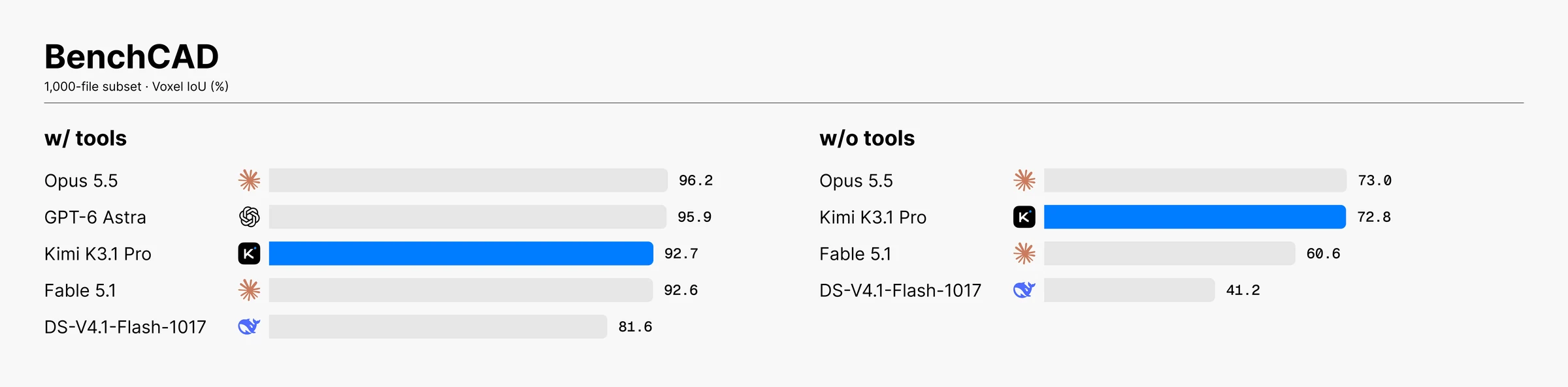
- BenchCAD: 92.7 percent with tools (Opus 5.5: 96.2 percent), 72.8 percent without.
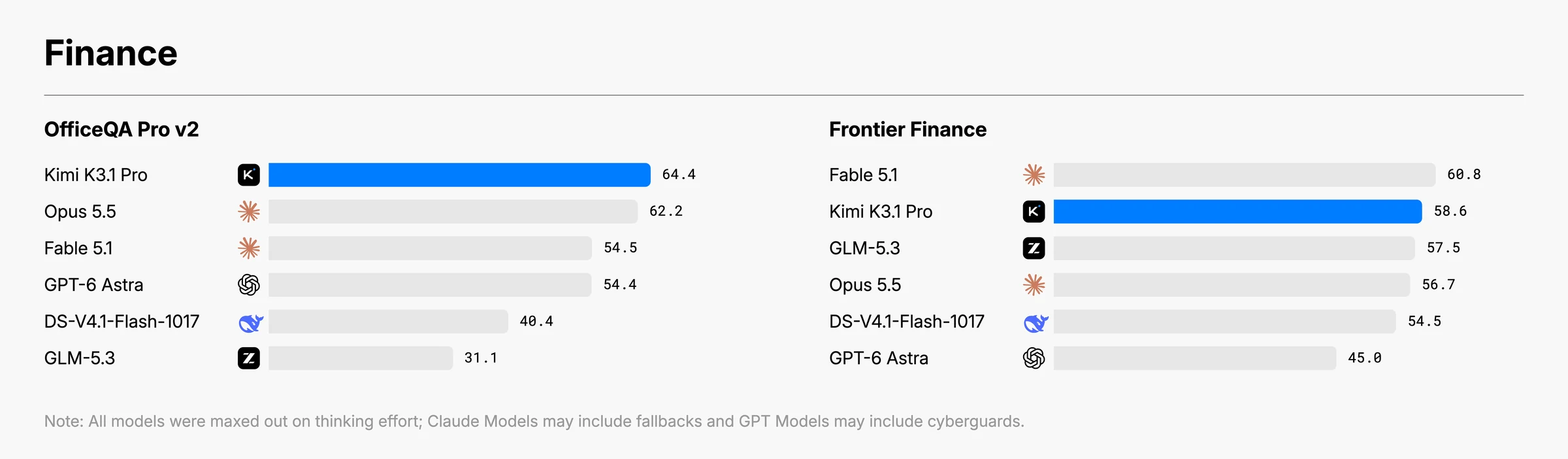
- OfficeQA Pro v2: 64.4. Moonshot says this is the best result in its field.
- Kimi Hallu Bench Hard: claim-level hallucination rate of 8.3 percent. On K3 it was 23.4 percent.
The last line is the most striking on paper: the fabrication rate dropping to under a third. But take another look at the test's name. Kimi Hallu Bench, Kimi Code Bench... The same house wrote the exam, sat the exam and graded it. I'm not saying these numbers are wrong. I'm saying no independent study could be found to verify them. And there's no hands-on, independent review out there yet either.
What do the independent measurements say?
Here the picture is a little more sober. On Artificial Analysis's Intelligence Index the model scored 55 and shows up 4th out of 221 models on its model page. In the same outfit's full list, where effort levels are counted as separate rows, there are four rows ahead of it: Claude Opus 5.5 at maximum effort (58), followed by three entries at 56 (Claude Sonnet 5.5 max, Opus 5.5 xhigh and Muse Wonder Full max). Kimi K3.1 Pro comes right after them. Saying "a little behind Opus 5.5" wouldn't be unfair, but a three-point gap isn't small enough to wave away either.
On Vals AI the picture is different: 8th out of 27 models on the Vals Index, with 62.52 percent. The gap between these two independent measurements tells you something: the model doesn't land at the very top in every ranking. Depending on what job you put it to, it can jump four places at once.
Blunting its own weapon
Now for the most interesting part of the piece. Moonshot says it removed cyberattack-related data from both mid-training and the reinforcement learning (RL) stage. And it wrote down the price in numbers: on its own xdev-bench-hard test (pass@3, meaning it counts as a pass if one of three attempts hits), the interim version without these measures scored 90.5 percent while the final model stopped at 81.0 percent. A loss of about 9.5 points.
You don't often see a company say "we deliberately weakened our model in this area, and here's how much weaker it got". The number again comes from their own tests, so the caution above applies here too. But writing the price down openly is far more honest than pretending there wasn't one. I respect that.
Who's it for?
The use cases Moonshot puts forward are coding, 3D/CAD generation (which it calls "3D Make"), financial modelling, and research and business operations. The BenchCAD numbers back up the second item. That gap of nearly twenty points between the with-tools and without-tools results, in particular, shows how much the model leans on tools for this job. Terminal-Bench and the long-horizon code test fit the first item too.
As for my verdict: K3.1 Pro is a serious model that sits just below the very top in independent rankings, looks cheap for long-context work thanks to its price and cache discount, and spells out in numbers exactly where it was weakened. The shiny numbers from Moonshot's own tests, though, are shop-window goods until someone independent gets their hands on them. And I won't use the "open weights" label before 4 November. If the weights arrive on that date and the licence turns out reasonable, this will be one of the most important open model announcements of the year. If they don't, what we're left with is a good but closed API, and that's that.
When the weights are out I'll take another look at both the licence and the first independent tests. In the meantime, if any of you put the model to work on your own stuff, write in. I'm curious what you see. Until next month, take care!
Sources
- Primary source kimi.com